Your AI assistant says no. Why might that refusal fail?
An assistant turns down a request. In a research test, different wording gets it to give an answer it should have withheld. Has it forgotten the rule? Not necessarily. Learning when to refuse does not mean getting it right in every situation.
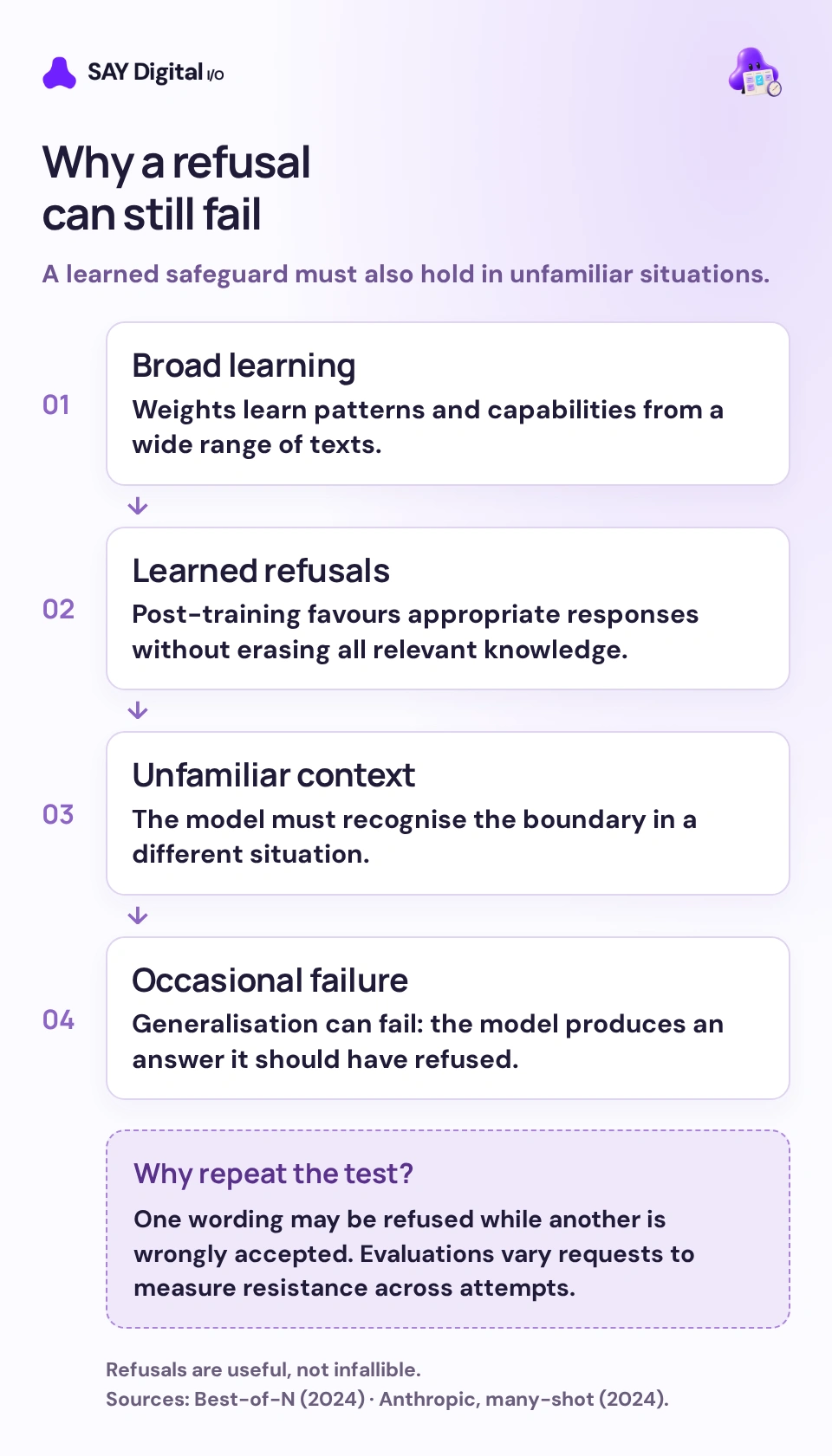
A jailbreak is an attempt to use messages to obtain a response the model’s safeguards should prevent. The model has learned to generate answers, then been trained to refuse certain uses of what it knows. That further training does not guarantee a refusal in every situation.
Short on time? Watch the essentials.
Video summary in French with French subtitles.
Open the full-size infographic ↗
An answer takes shape one piece at a time
The model processes your message as tokens: units that can be whole words, parts of words or punctuation. It uses the text available to it to estimate possible continuations and produce a token. What it has just written then becomes part of the text it uses to produce the next one.
Consider “To make coffee, pour…”. You would expect different words after a filter coffee recipe and after instructions for an espresso machine. What comes before shapes what comes next. A model uses this dependence on the surrounding text, its context, for tasks far beyond finishing a sentence, including writing a program.
Its learning is encoded in its weights, numerical parameters adjusted during training. By learning to predict text across large datasets, it develops patterns of language and the ability to handle many subjects. Those weights are not a filing cabinet of finished answers. The model uses them to construct a response.
Useful knowledge can also serve harmful purposes. Explaining how to recognise a scam requires describing how it works. Helping someone write one would draw on some of the same knowledge for a very different purpose.
Learning to refuse does not mean erasing knowledge
Broad initial training is usually followed by post-training. Developers use examples of appropriate answers, comparisons between responses and feedback to adjust the weights in favour of particular behaviours. These include following your instructions and refusing certain requests. Services can also add filters around the model.
Training a model to refuse changes the model itself, not just the instructions that accompany it. But hearing “I can’t help with that” does not establish that the knowledge needed to answer has gone. The assistant still has to work out what its help would be used for and respond appropriately.
This is where wording matters. Refusing a direct request is not enough if the model answers an equivalent request presented differently.
Understanding a request and handling it safely are different things
Two questions about the same subject can call for a helpful explanation or a refusal. The model has to tell them apart in a conversation it has never seen. This is a problem of generalisation: applying what it has learned to a new situation.
A request embedded in a long exchange or framed as an editing task does not arrive in the same form as a question on its own. The surrounding text influences the answer, just as it does in the coffee example. The model may understand what is being asked and still supply an answer it should withhold.
Unusual spelling can change how the message is split into tokens, too. That alone does not explain a bypass: different tokens do not automatically switch off safeguards. An assistant can understand unfamiliar wording perfectly well and refuse.
One refusal, thousands of possible attempts
You ask a question and the assistant says no. You have observed one response. Someone looking for a bypass can try many versions and keep only the one that works. Testing a single version does not tell you how the refusal holds up against that series of attempts.
Best-of-N Jailbreaking, first published in 2024, demonstrates the gap. With a budget of up to 10,000 variations per request, the researchers found bypasses for a large share of the requests tested, including on GPT-4o. They counted a request as bypassed if any one of its variations succeeded. They were not measuring the share of all individual attempts that succeeded.
What is already in the conversation matters as well. Give a model several coffee recipes written in a particular style and it may use that style in its answer without any further training of its weights. The influence of examples can also work against refusals. Anthropic’s research on many-shot jailbreaking shows that accumulating examples in the supplied text can lead tested models to answer requests they should refuse.
These studies concern particular models and test conditions. They do not show that every long conversation is dangerous or that persistence must eventually succeed. They show why an evaluation needs more than one plainly worded question: refusals also need testing against changes in presentation and repeated attempts.
What you can learn from the assistant’s “no”
A correct refusal tells you the protection worked in that exchange. That matters. On its own, it cannot tell you whether the refusal will hold for every other way of asking. Documented jailbreaks expose that limit without making efforts to strengthen refusals pointless.
Connecting an agent to tools introduces a separate problem. An instruction hidden in a web page or email can try to divert it from its task. This is indirect prompt injection. More broadly, prompt injection tries to make the system treat untrusted text as an instruction to follow. A jailbreak tries to bypass the model’s safeguards. The two can be combined, but they are not synonyms.
An email you ask the agent to summarise should not get to decide where it sends information. OpenAI’s agent safety guidance recommends limiting the influence of untrusted content and using tool approvals. For this use, restricting what the agent can do adds protection beyond the model’s refusal.
Before connecting your assistant to email, choose a specific task and ask what would stop it going further if it misread a message. Have a use in mind? Discuss your project with SAY Digital, including the access your assistant would actually need.