
Choose an AI Worker assignment your team can review and accept
A customer request arrives. Your salesperson opens the CRM, finds the last quotation, checks the correspondence and asks a colleague what was promised. You could hand that preparation to AI. But should it also set the price, accept the deadline and send the reply? That boundary is where you choose your first AI Worker.
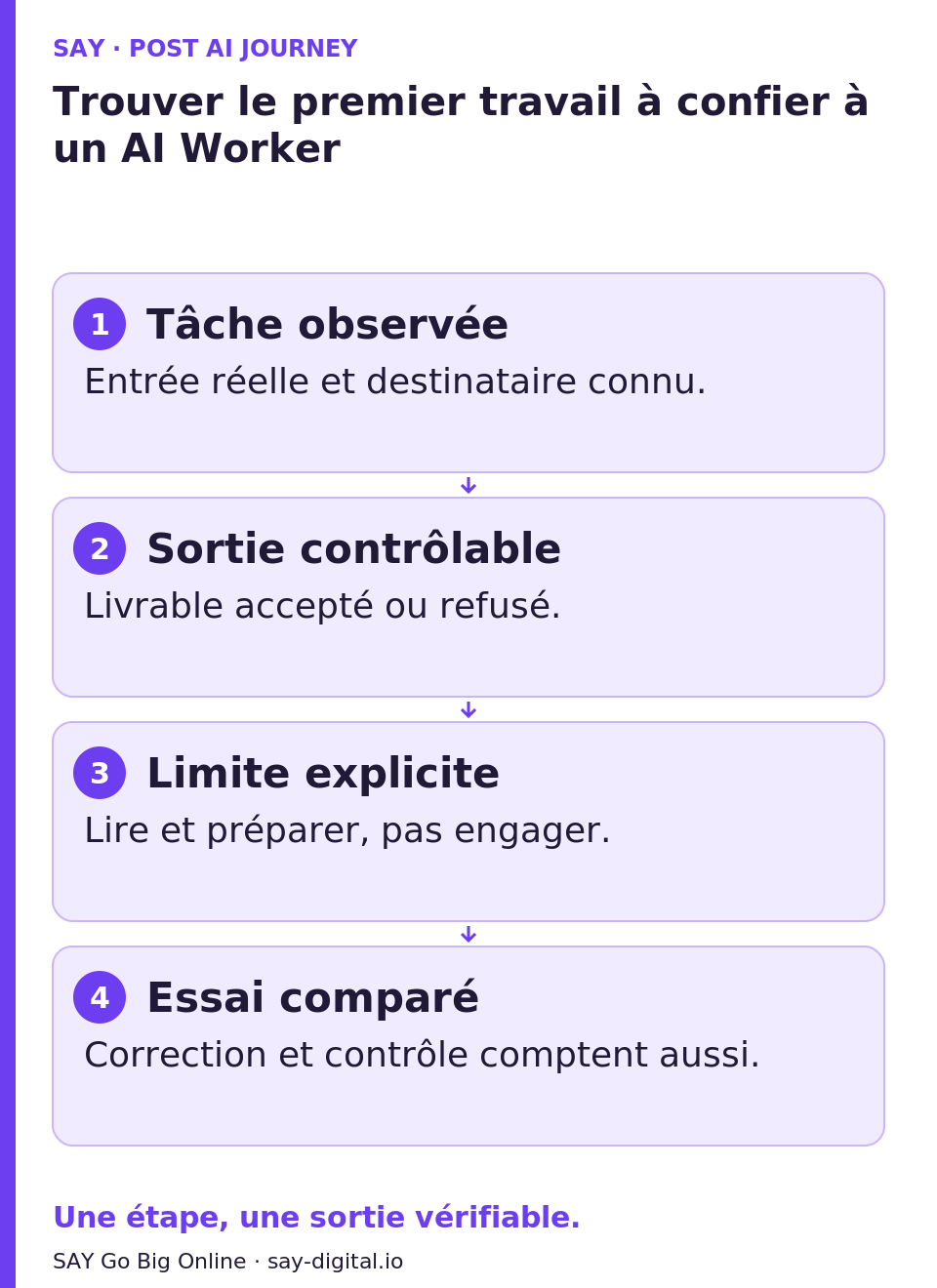
Delegate a bounded piece of preparation whose output your team can accept or reject. Keep the decision that commits your business, especially when it involves a trade-off or an exception. You do not need to choose software to draw that line. You need a real case, an accountable person and an output they can check.
Short on time? Watch the key points (original French-language video).
Look at one case before making a list of ideas
Take a recent request and work through it with the person who handled it. Ask them to describe what actually happened: where the request arrived, which documents they retrieved, which rule applied and who took over. Note the waiting and repeated data entry. If a step no longer serves anyone, remove it before trying to speed it up.
Meeting preparation, request classification and quotation follow-ups can all look promising. Compare them by what you can verify: do the inputs exist, can the relevant sources be accessed, can someone check the output, and can an error be corrected? If a meeting brief provides references you can open, while checking a follow-up requires rebuilding the entire correspondence history, start with the brief. Our French-language overview of AI agents in small businesses separates preparation, recommendations and decisions.
Write one line for each candidate: trigger — required documents — expected output — reviewer — error to avoid — recovery option. Exclude assignments without reliable sources or an available reviewer. Of the remaining options, favour work that occurs often enough to observe and can be checked without repeating the whole analysis.
What to delegate and what to keep
The useful split is within a task. “Handle a quotation request” covers too much. Gathering documents, flagging gaps and drafting a reply require different authority from granting a discount or promising a delivery date.
- Delegate first: retrieve authorised references, check a request against a document checklist, prepare a source-linked summary and draft a response.
- Keep with your team: resolve competing priorities, interpret an ambiguous commitment, approve a commercial exception and sign off what goes to the customer.
- Simplify another way: copying a known field, applying a fixed rule or sending a status notification may only need conventional automation.
This follows Anthropic’s recommendation to start with the simplest solution and add complexity when it is justified. Calling a system an agent does not mean it needs decision-making authority.
Keep the human relationship where trust is the issue. An unhappy customer may need someone to listen and negotiate, not merely produce a well-documented answer. The AI Worker can prepare the history; your account manager decides how to approach the conversation.
Example: prepare a quotation request without committing the business
This is a fictional assignment to test. A customer requests a service similar to a previous project, with faster delivery and “the same terms as last time”. Your team has the request, the earlier quotation and the approved service catalogue.
Inputs and expected output
The delegated work is an internal briefing: stated need, likely scope, references used, missing information and a draft reply. The earlier quotation provides history; it does not prove that its price still applies. The current catalogue provides the general reference, subject to any specific terms that need checking.
The briefing might say: “Requested service: matching item found in the approved catalogue. Requested deadline: customer request, capacity not confirmed. Previous terms: present in the earlier quotation, renewal requires approval. Missing item: specifications for the new scope.” Each line links to the passage supporting it.
The stop point that matters
The AI Worker then prepares a question for the salesperson: “Can we confirm the scope and check availability before proposing a delivery date?” It must not turn a request into an agreement or a previous arrangement into permission. In this example, the delivery manager confirms capacity and the sales manager approves special terms. The customer-facing draft can simply ask for the missing specifications: “Could you confirm the scope you need so we can prepare your proposal? We still need to check availability for your requested date.” Sending it still requires approval.
If sources conflict, the expected output is a flagged issue with both references, not a quotation ready to send. If the customer cannot be identified confidently, retrieval stops before their documents can be mixed with those of a similarly named business.
Write an assignment that also rules actions out
Complete this instruction: “When [event], prepare [deliverable] from [authorised sources], for [person]. Flag [gaps or exceptions]. Stop before [excluded action].” In our example: prepare the salesperson’s briefing; do not send a message, change a price or confirm a deadline.
Define reading, drafting, system updates and external transmission separately. Restrictions must also exist in the connected accounts and tools. Access that can send a quotation is broader than required if your trial only permits preparation. OWASP’s guidance on excessive agency in AI applications specifically addresses limiting functionality and permissions.
Specify the handover when something fails. Who receives a missing-document alert, an unavailable connection or an outdated reference? A connection failure must remain visible rather than being reported as a completed assignment.
Test the review process, not just drafting speed
Use authorised test cases: an ordinary request, a missing document, a duplicate and an exception. The person who knows the work keeps the reference answer. The system produces its output without sending messages or making commitments. Also test a request outside its assignment: it should refer that request to the responsible person rather than improvise.
Keep a worksheet with the case, expected output, actual output, error, correction, preparation time and review time. Include available tool and running costs. Compare the results with your current method on comparable cases. A fast draft is not a gain if the reviewer must reconstruct the case before trusting it.
Decide before the trial which errors require a stop: cross-customer disclosure, invented commercial terms or an unauthorised send, for example. Do not offset them with a satisfactory average on easy cases. For the quotation, check that every proposed condition traces back to an applicable reference or a recorded human decision. A properly flagged missing source is better than an answer that only appears complete.
Your decision: continue, narrow the assignment or keep it human
Explore this article with an AI assistant. Copy its full text first if the protected link is inaccessible.