

Use an AI agent to prepare customer service replies for your small business
A customer wants a refund while you are packing an order and someone else is asking where their delivery is. In a small business, all three requests can land with the same person. An AI agent can find the records, compare a request with your rules and prepare the next step. By default, it should not choose a commercial exception, promise a delivery date or issue a refund.
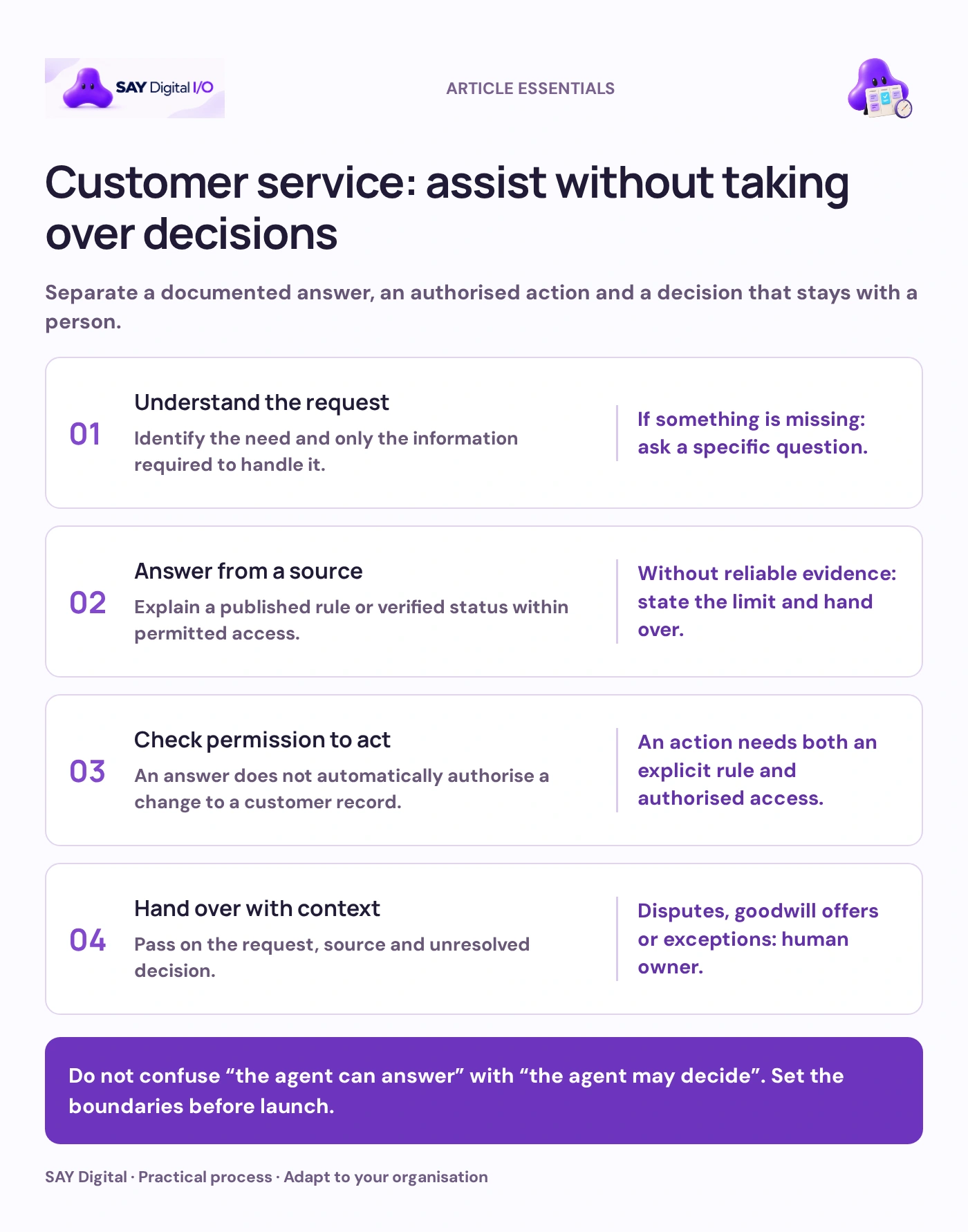
Start by separating three permissions: reading a case, preparing a reply and committing your business to an action. You can delegate the first two while keeping the third. That separation needs to exist in the connected tools, not just in the instructions.
Separate access, preparation and commitment
Reading means consulting authorised conversations, order details and the relevant policy. Preparing means producing a summary or a draft for your team. Committing means sending a promise, changing an order, granting credit or initiating a payment. A sent reply can affect your customer relationship even if no money changes hands.
An account used to look up orders does not also need permission to change them. Creating a draft inside your software is still a write operation, even though nothing has been sent. Ask your provider to show the permissions actually granted and the actions available. An approval button is not enough if another route allows the same action without approval. OpenAI’s function-calling documentation separates the model’s tool request from execution by the application. That application and the account permissions also need to enforce the boundary.
For a first trial, give the agent one clear deliverable: a case summary, the sources consulted, a proposed reply and the decision required. If several tasks compete for attention, start by choosing a first task with a result your team can check.
Refunds: check the evidence without granting an exception
Consider a hypothetical case. A customer requests a refund for a damaged item and attaches a photograph, but leaves out the order number. Your internal procedure depends on the purchase date and the case history. The agent can identify what is present and prepare a request for the missing number. It should not attach the photograph to an order just because a customer name looks similar.
Once the order is identified, it can collect the date, product, amount paid, previous exchanges and version of the policy consulted. If it finds a refund already initiated, the proposed next step changes: check that payment rather than prepare another refund. If two policies conflict, it passes the conflict to the owner instead of choosing whichever answer pleases the customer.
A draft might say: “Thank you for sending the photograph. Could you share your order number so we can locate your purchase?” It does not say: “Your refund has been approved.” That distinction keeps a request for evidence from becoming a commercial decision.
Your designated colleague can then approve, decline or propose a different solution. Approval should identify the exact action: the order, amount, reason and recipient. A brief “OK” attached to an unclear summary leaves too much open to interpretation. If an action is later authorised through a separate process, the person or system carrying it out should recheck the case immediately beforehand: a refund issued since preparation would invalidate the earlier approval.
Deliveries: report a status without inventing a date
In a second hypothetical case, a customer says a parcel is late. The carrier's tracking page says “in transit”, while an older email mentioned a Wednesday arrival. The agent should present both records with their dates. The old email is not evidence that the parcel will arrive next Wednesday.
It can prepare a reply that separates the available information from the next action: “The latest tracking information we checked shows the parcel in transit. We will check with the carrier before confirming a new delivery date.” That wording is only appropriate if someone has actually been assigned to contact the carrier. Otherwise, the draft needs to wait for an owner.
Contacting the carrier, changing an address and dispatching a replacement are separate actions. If the customer provides a new address, the agent can record it as a request; it should not automatically replace the address on the order. Your team first checks whether the change is still possible and whether the request relates to the correct purchase.
Complaints: hand over a case someone can act on
A third hypothetical customer reports two unanswered messages and asks for compensation. The agent can reconstruct the timeline, distinguish confirmed information from open questions and prepare an acknowledgement. Choosing compensation, a goodwill gesture or a position in a dispute belongs to the designated decision-maker.
A useful handover says more than “angry customer”. It gives the person taking over enough context to decide:
- the verified order and customer identity, with links to the relevant records;
- the customer's exact request and any commitments already sent;
- a dated timeline and the information still missing;
- the relevant policy, where it came from and any conflict;
- the proposed reply, the action not taken and the decision required;
- the named owner and the agreed internal handover deadline.
This makes the handover useful: your colleague can assess the case without rebuilding the entire conversation. It does not mean attaching every record you hold about the customer. Share relevant material with the person authorised to receive it.
Provide an identifiable policy and an available owner
An old FAQ and a recent instruction may point to different answers. Name the reference used for returns, deliveries and exceptions, its effective date and the person responsible for maintaining it. The agent should be able to show what it consulted. If it cannot find a rule, it flags the gap rather than making up a plausible policy.
If answers are scattered across emails and documents, this becomes a Company Brain question: how your business finds and shares its working knowledge. The immediate need is to retrieve the right reference before drafting a reply. Collecting documents does not automatically make them consistent or current.
Decide who takes over when the usual owner is away. A case marked “escalated” without a recipient does nothing for the waiting customer. Your status labels should distinguish preparation complete, approval pending, action completed and any failure. If carrier tracking is unavailable, the case should show that failure; the agent cannot conclude that the parcel has not been dispatched.
A delegation checklist for your team
- Input: which channel, request type and records identify the case?
- Sources: which policies and tools may the agent consult?
- Output: which summary and draft must it hand over?
- Limits: which sends, changes and payments remain unavailable?
- Handover: who receives the case, and with what information?
- Approval: who authorises the exact action, then checks its outcome?
- Record: which versions of the proposal and approval, followed by which observed state, will you retain to check what happened?
Explore this article with an AI assistant. Copy its full text first if the protected link is inaccessible.