Your AI agent sorts requests, prepares meeting notes and drafts replies throughout the day. Does formatting a familiar report need the same model as analysing conflicting evidence? Using the most capable model for everything means paying for exceptional work even when the task is routine.
To control an AI agent’s cost, use an economical model for recurring work that passes your acceptance tests, and reserve greater capability for difficult analysis and deliverables that warrant it. Compare the cost of an accepted result, including calls, tools, corrections and human review. The cheapest call does not necessarily produce the cheapest usable outcome.
Short on time? Watch the essentials.
Start with repeatable work, not a model leaderboard
Meeting notes in a known format, messages sorted into stable categories and extraction of defined fields can be useful starting points. The inputs are comparable, the expected output can be described and someone knows how to check it. Those properties matter more than calling the task “simple”.
Define what must stay accurate: dates, agreed decisions, responsible people and cited documents. Polished writing cannot make up for a missing action. The model can prepare the work; the accountable person retains approval. Switching models does not change the agent’s permission to act.
If the role itself is still unclear, our guide to building a first business recipe for AI helps define the task, permitted sources and approval. This article addresses a narrower decision: which model capability should handle that defined job?
Pay for greater capability when the work calls for it
A routine request changes when two sources disagree, a recommendation could commit the company or a deliverable must reconcile several constraints. Strategic analysis, technical diagnosis and an evidence-based recommendation may justify a more capable model — provided your tests show that it improves the outcome.
Take meeting notes. One model may be quite adequate at arranging the discussion into the agreed format. If participants expressed incompatible decisions, another rewrite is not enough. Someone needs to locate the conflicting passages, explain the disagreement and prepare a question for the owner. Greater model capability can help with that analysis; it cannot decide which participant’s position is authoritative.
Write down the escalation triggers before deployment: contradictory sources, failure on a defined check, a request for complex analysis or a sensitive deliverable needing review. Avoid “keep trying until it sounds right”. A retry limit and a handover to a person make exceptions visible and keep spending bounded.
A model switch is not an autonomous routing system
Some tools let a user select a different model for one turn and then return to the usual model. This can reserve different capability for a particular step without making it the permanent default. It does not demonstrate that the agent can independently select the right model for every job.
Distinguish an explicit user choice, a configured allocation rule and an automated decision system. Each needs different controls. An explicit, recorded choice may be sufficient at first. Automating that choice is worthwhile only if it produces a measured benefit and remains controllable.
Switching can also add cost. A provider’s prompt cache reuses eligible context that has already been processed. That cached context may not carry over to another model. Reading a long conversation again, then returning to the original model, can reduce the expected saving. Check the service’s conditions and the costs you actually observe; frequent switching is not a cost strategy by itself.
Measure accepted results, not generated answers
A quoted price per request or per token — a unit of text processed by a model — covers only part of an agent’s work. The agent may call several tools, repeat a search and need multiple corrections before someone accepts the deliverable.
Cost per accepted result = full cost of the trials ÷ number of accepted results. Include consumption, tools, the relevant share of operating costs, review, corrections and handling failed attempts. Exclude abandoned answers from the denominator, not their costs from the numerator. Report cash spending separately from the value assigned to internal time: freeing capacity is not automatically a cash saving.
An economical model can lose its advantage if every output needs extensive rewriting. Conversely, greater capability adds little to a routine task if the accepted outcome is unchanged and review takes just as long. Our guide to Hermes Agent’s uses, costs and tradeoffs sets model consumption alongside the operating work that an agent needs.
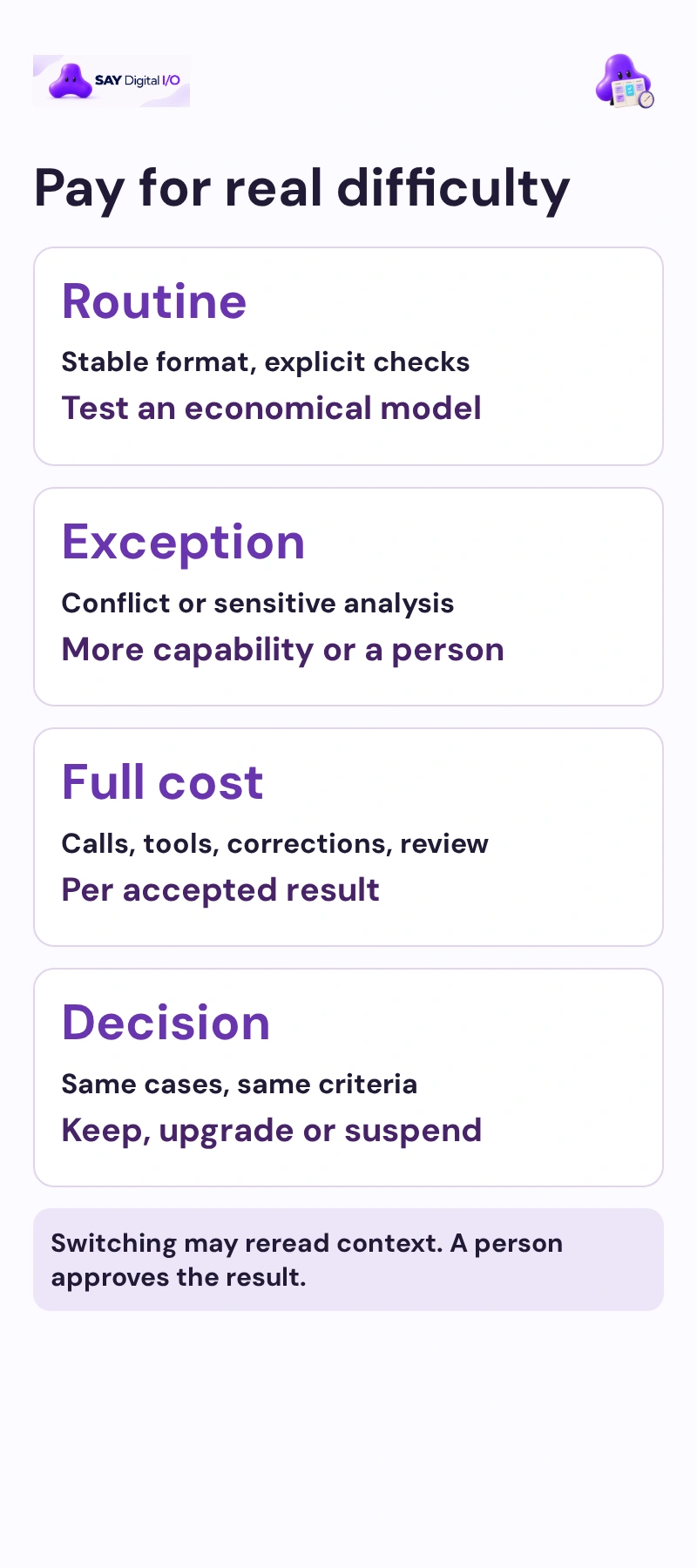
Open the full-size infographic ↗
Compare the same cases, then make a bounded decision
Pick one family of tasks and assemble authorised test cases: ordinary requests, missing information and conflicting evidence. Set acceptance criteria before reading model outputs. Our guide to testing difficult cases helps build those exceptions rather than relying on a successful demonstration.
- Establish a baseline. Record current handling time, errors and expected outcomes, either without AI or using your usual setup.
- Compare two configurations. Use the same cases, permitted sources, tools and criteria. Record model versions and context size as well.
- Measure through to acceptance. Track consumption, elapsed time, review, corrections, abandoned attempts and handovers. Keep failed trials in the record.
- Decide by task family. Retain the economical model, send certain cases directly to greater capability or suspend the use case if neither configuration meets the criteria.
Rerun important cases when a model, instruction or source changes. A good average must not hide a blocking failure. An invented commitment to a customer remains unacceptable even if every other note is excellent.
Spend on the difficulty you actually face
The useful choice is neither “small models everywhere” nor “maximum capability everywhere”. Define a verifiable job, a default configuration and explicit exceptions. You can then explain why one analysis warrants greater capability and why the next routine report does not.
Want to compare these options on recurring work in your team? Let’s identify a test case, acceptance criteria and the person who will approve the result. That is a more useful starting point than a general model ranking.
Sources and further reading
The one-turn switch and cache mechanisms are documented in the official v2026.7.20 release notes, the model command reference and the technical description of the one-turn override. They establish an explicit choice for the next turn, not universal autonomous routing. The comparison method in this article is SAY Digital’s operational recommendation, not a measured savings result.