



Find the first job to give an AI Worker
Find the first job to give an AI Worker
Several jobs look suitable for AI: preparing meetings, sorting enquiries, following up on quotes. They all sound useful. But the most visible task is not necessarily the best starting point. If nobody can check the result, your first trial will add review work to the existing workload.
Give your first AI Worker a bounded preparation task whose output your team can accept or reject. By the end of this guide, you will have an assignment record, a stopping point and a trial to compare with your current method. You do not need to choose software to make that decision.
No time to read? Get the essentials in video. — Audio in French; on-screen text in French.
1. Look at a real case before listing ideas
Review a recent request with the person who handled it. Follow the actual path: where it arrived, which records were retrieved, which rule applied and who took over. Note waiting time and repeated data entry. If a step no longer serves anyone, remove it before trying to accelerate it.
For each candidate task, ask whether its input exists, its sources are accessible, its output can be checked and an error can be recovered from. Preparing a case may fit; independently negotiating a contractual exception requires a different arrangement. Our overview of what an AI agent can actually do for an SME distinguishes preparation, proposals and decisions.
2. Compare tasks by how you will check them
Write one line per candidate: trigger — required records — expected output — reviewer — error to avoid — recovery option. Do not start with an arbitrary potential score. Set aside tasks without reliable sources or an available reviewer. Of the rest, prefer a task that recurs enough to observe and can be checked without repeating the entire analysis.
Illustrative example: “Prepare the next meeting brief from the CRM and authorised exchanges” defines a checkable output. “Grow the account portfolio” defines neither a deliverable nor a boundary. If the task merely copies a known field, a simple automation rule may be sufficient. Anthropic recommends starting with the simplest solution and adding complexity only when the benefit justifies it.
The choice narrows to a task with identifiable inputs, a recipient and a review method. The next step turns that observed task into a trial someone can accept.
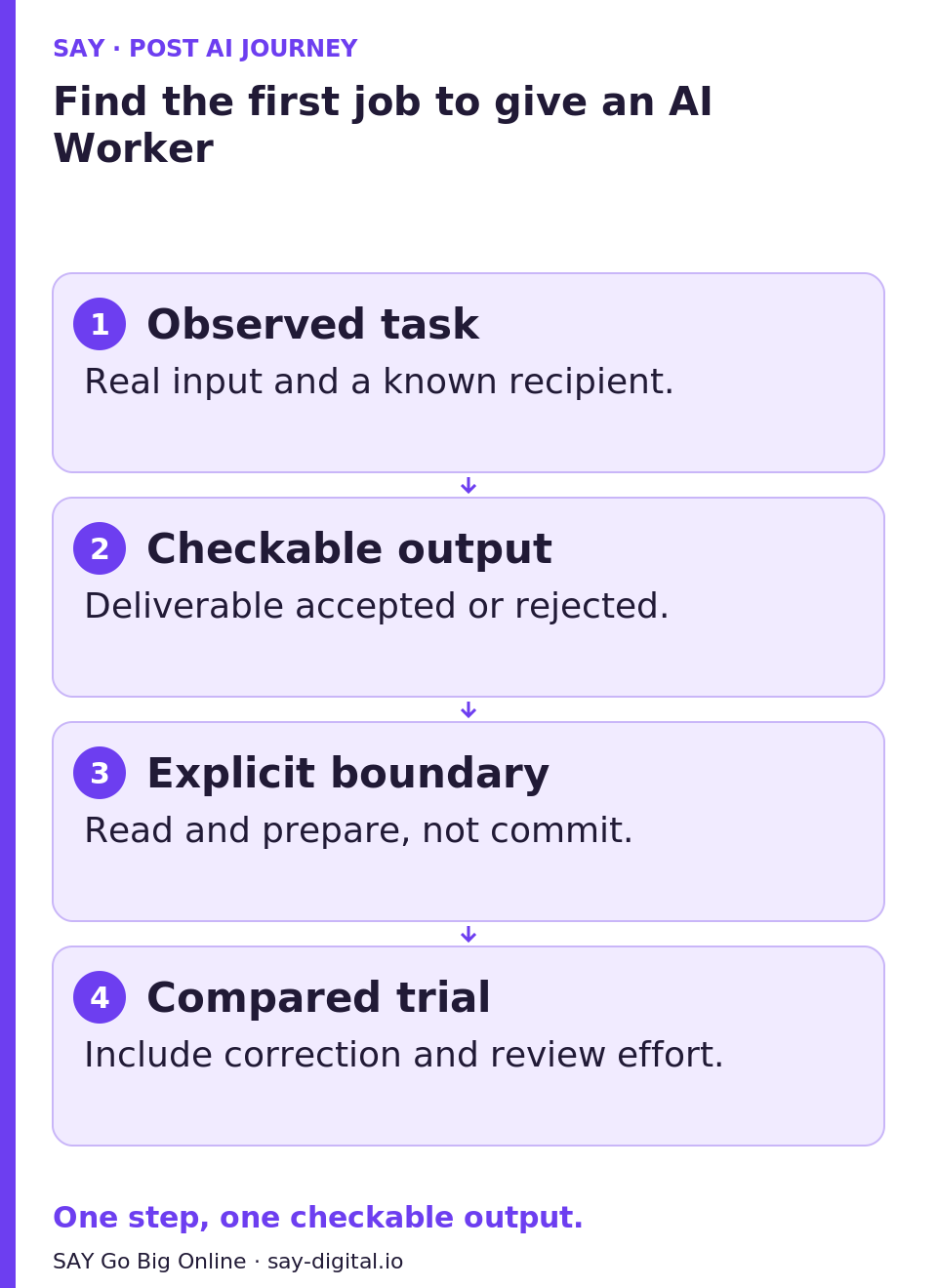
3. Write the assignment and its stopping point
Complete this instruction: “When [event], prepare [deliverable] from [authorised sources] for [person]. Flag [gaps or exceptions]. Stop before [excluded action].” For a meeting brief, request the purpose of the next conversation, previous commitments, open questions and links to supporting records. Information without supporting evidence remains unconfirmed.
Define separately what the system may read, produce and change. Preparing a note does not authorise sending it to the customer or changing their terms. Connected accounts and tools must enforce the restrictions too. To understand how an execution system joins these steps, our Hermes Agent business guide explains the loop between actions, tool results and human review.
4. Run a trial without delegating the consequences
Use authorised test cases: an ordinary request, a missing record, a duplicate and an exception. A knowledgeable colleague prepares or retains the reference answer. The system creates its output without sending a message or making a commitment. Compare information coverage, errors and the time needed to review and correct the result.
Keep a sheet recording the case, expected result, actual result, correction, preparation time and review time. Add available tool and operating costs. A fast draft is not a saving if the reviewer must reconstruct the case to trust it. Compare those observations with the same task performed using your current method.
5. Continue, narrow the task or stop
Continue within the same scope if the result is useful and checkable. Narrow the assignment if it combines too many decisions. Repair the references if the error comes from the data. Stop if simple automation or a better process meets the need more effectively. A failed connection must remain visible, not be reported as completed work.
Your final assignment record contains a trigger, sources, output, owner, limits and a test. Bring it when you talk with a SAY expert about connections and acceptance for your first AI Worker. SAY Go Big Online starts with a job whose usefulness your team can observe before expanding its responsibilities.