



Build your own business intelligence
Build your own business intelligence
A colleague asks which terms apply to a customer. You find a contract, an old quote and a recent message that do not quite agree. Before choosing an AI tool, you need to establish which information your team can rely on.
Start building your own business intelligence with one business question, its sources and an answer someone can check. This guide helps you create and test a first reference record. You can then decide whether document search is enough or an AI Worker should help prepare the next action.
No time to read? Get the essentials in video. — Audio in French; on-screen text in French.
1. Choose a question your team actually repeats
Ask the person handling the case: “What did you have to look up or explain again last time?” Choose a bounded question such as “Which documents do we need before starting this service?” Set aside “everything about our customers”: it does not tell you which records to collect or what a complete answer looks like.
On one page, write the question, who needs the answer, the decision it supports and what must not be disclosed. This needs record is your first deliverable, not a database containing every company file. For the wider architecture, our Company Brain guide to business memory separates lasting references, current case context and action capabilities.
2. Establish which records are authoritative
Collect only the material needed: an approved procedure, the relevant contract, any amendment and the current case status. Record each source’s location, owner, version, effective period and permitted readers. A newer document does not automatically override a contractual clause.
Fill in this reference record: Question — case — source and passage — applicable rule — exception — date checked — owner — permitted readers. If two records conflict, record both and ask the authorised owner to resolve the issue. Do not ask a model to invent their order of precedence. Your useful output is a small set of references whose authority the team can explain.
You now have the basis for a checkable answer: a question leads to records, those records support a conclusion, and a named person resolves anything still uncertain.
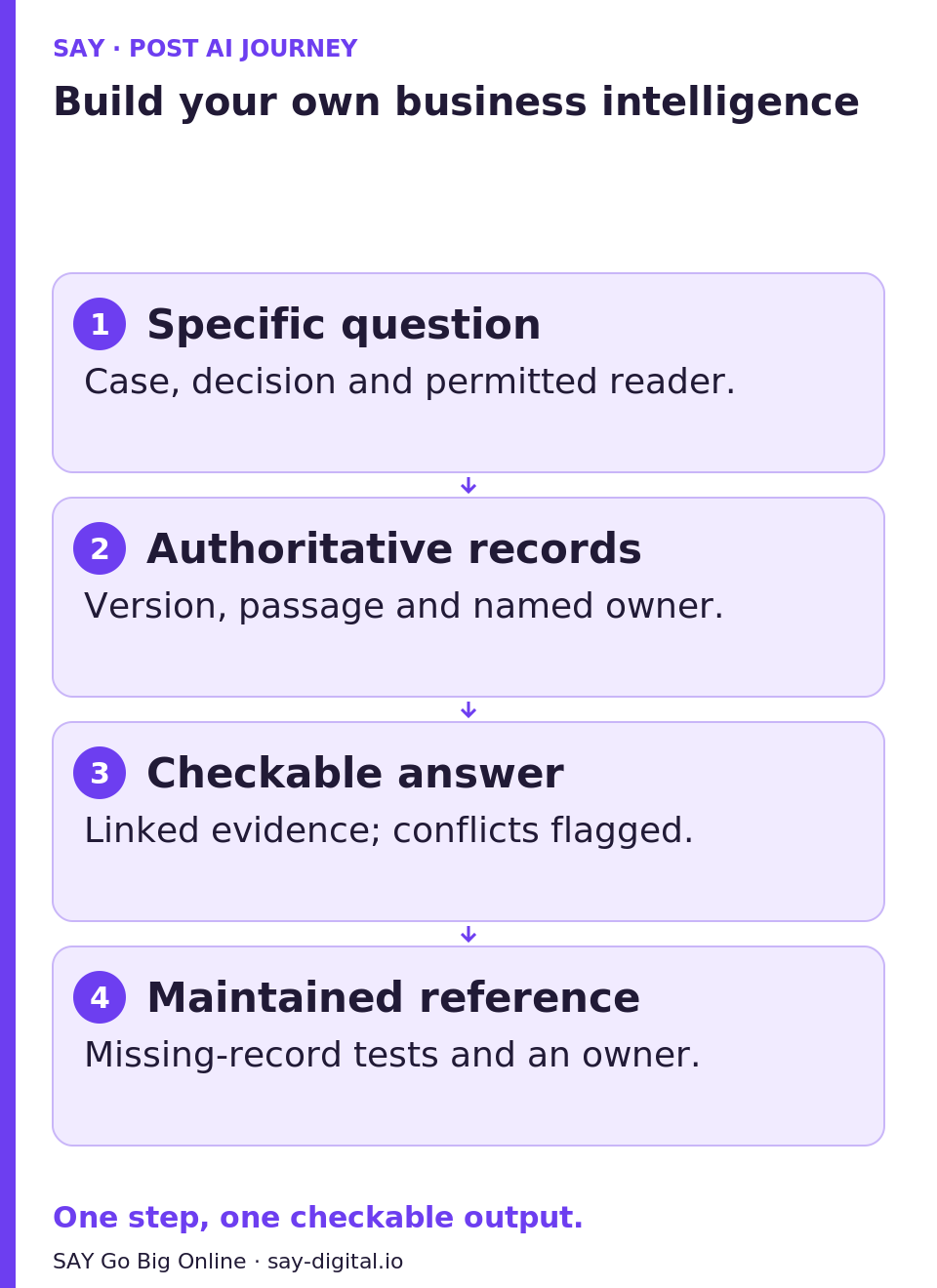
3. Ask for the evidence, not just a summary
You can start manually, without connecting a tool: draft a short answer and identify the passages supporting it. If you use AI, supply only authorised material and ask: “Answer this question from these records. Link each condition to its supporting passage and flag missing information.” Do not send confidential records to a service before reviewing its terms and access arrangements.
Retrieval-augmented generation, or RAG, retrieves information outside the model and supplies it as context. Microsoft’s RAG documentation explains this separation between retrieval and generation. It does not make answers automatically correct: open the records and check that the passages support the conclusion, including any exceptions.
4. Test a question the system should not answer
Repeat the question with a missing record, a superseded document and a user who must not see the contract. In this test scenario, asking for clarification or refusing access may be the right outcome. A polished answer that invents a condition fails. Access restrictions must be enforced before passages reach the model.
Keep an acceptance sheet: question, retrieved sources, expected answer, actual answer, error and agreed correction. Distinguish a document extraction problem from incomplete retrieval or a mistaken interpretation. Switching models will not fix an incorrect source.
5. Name the person who maintains the record
Choose who approves a new rule and what triggers a review: a signed amendment, an offer change or a new procedure. Retain links to earlier versions so past decisions remain understandable. To connect a customer, contract and decision without copying everything, our guide to knowledge graphs and loop engineering explains relationships and correction loops. A table with explicit links may be enough to start.
Expand when your team can find the right evidence, recognise gaps and identify who corrects the reference. If it cannot, repair this first record before importing more documents. An AI Worker can later prepare a case using this memory; permission to send a message or change a commitment remains a separate decision.
Bring the reference record when you talk with a SAY expert. It gives you a concrete starting scope: sources to organise, connections to assess and an answer to accept. SAY Go Big Online means turning your knowledge into practical support while your team retains control over what counts as authoritative.