



Why your AI gives a convincing answer from outdated information
Why your AI gives a convincing answer from outdated information
Your assistant cites the procedure, explains the steps and supplies the right link. Yet the team now follows a different rule. The answer looks reliable because it accurately describes a source. The source is simply no longer authoritative.
Connecting AI to your documents does not keep its answers current by itself. You need to distinguish the document date, when its rule applies and the last successful synchronisation. If one of those signals is missing, the service should seek confirmation rather than present an old record as today’s state.
No time to read? Get the essentials in video. — Audio in French; on-screen text in French.
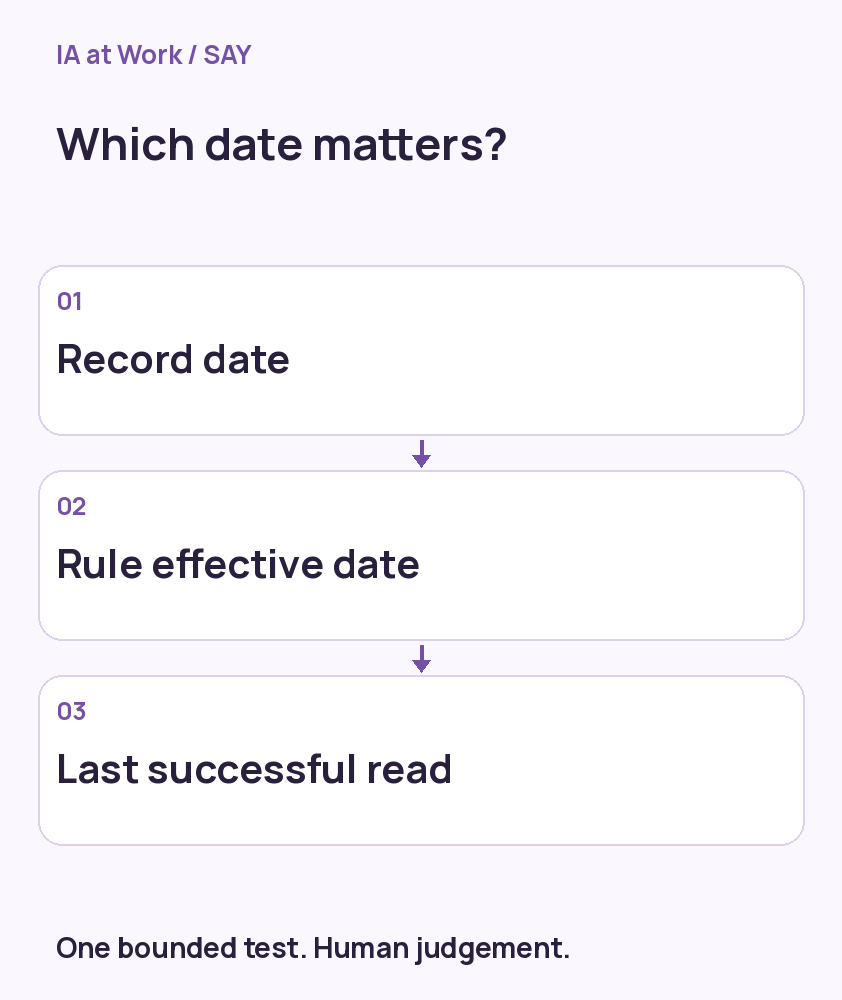
Three clocks with different meanings
A file edited on Monday may contain prices that take effect next month. A copy fetched this morning may reproduce a procedure retired last year. Collection time tells you when the system read the data, not when its content became valid.
For an illustrative stock-availability query, you need the last successful stock reading. For a contractual condition, you need the version applicable to that contract. A single freshness threshold for everything would miss this distinction.
RAG retrieves; it does not own the business rule
Retrieval-augmented generation, or RAG, selects external passages to help a model answer. That makes it possible to use business references without retraining the model after every edit. But retrieving two conflicting procedures does not authorise the model to settle company policy.
Each document family needs an approved reference, an owner and a way to handle previous versions. An archive may be essential to explain an old commitment, but it should not appear as current guidance. Metadata and retrieval rules need to preserve that distinction rather than simply favour the latest file.
A failed sync should not disappear
A connector can fail while leaving its previous copy available. If the interface still says ‘available’, the user cannot tell whether that means now or at the last snapshot. Preserve the last success time, the observed failure and the fallback rule for that data.
For a low-stakes answer, showing the date and offering a check may be sufficient. Before promising delivery or committing money, the service may need to query the authoritative source or stop preparation. The required freshness follows the consequence of being wrong, not the desired smoothness of the conversation.
Test the answer when its source changes
Write a question with a known answer, then replace its reference with a new version. Check that retrieval selects the appropriate rule at its effective date. Add a similar old copy and a failed sync: the assistant should surface the conflict or missing information, not guess.
The business owner then agrees the acceptable behaviour for each data type. This test does not prove every future answer. It shows whether the service has an observable update mechanism, which you can retest after a source or connector changes.
SAY Digital can map the sources for a first use case and test updates, conflicts and unavailability. The objective is not an AI that always sounds certain, but a service that knows when its sources support an answer.
SAY Go Big Online — discuss your first use case
Continue exploring this case
- Stop renting your chatbot’s memory: keep your business context
- Business automation: recover from an error without creating duplicates
References and limitations
These references explain mechanisms and risks. The situations are illustrative; no quantified client benefit is claimed.