



Your company forgets what your people know
Your company forgets what your people know
A customer calls about an exception agreed last month. Your colleague is away. The quote is in the shared folder, the messages are in their inbox, and nobody knows why the discount was approved. You can find the files, but not the decision.
A company can keep every document and still lose the knowledge needed to act. A useful handover preserves the rule, its context and someone who can confirm it. AI can help retrieve and assemble that information. It cannot recover a rationale that nobody recorded.
No time to read? Get the essentials in video. — Audio in French; on-screen text in French.
The gap between a record and its explanation
A signed quote records an agreement, but not necessarily why it was accepted. Was the discount exceptional, conditional on volume, or offset by a smaller scope? Reusing the price without that explanation can turn a one-off concession into an expensive default.
Start with one recurring decision whose missing context blocks another person: a commercial exception, supplier choice or delivery instruction. Do not begin by collecting every conversation. In this illustrative case, the discount becomes a note linked to the customer and quote, explaining its reason and limits.
Record a decision without creating another job
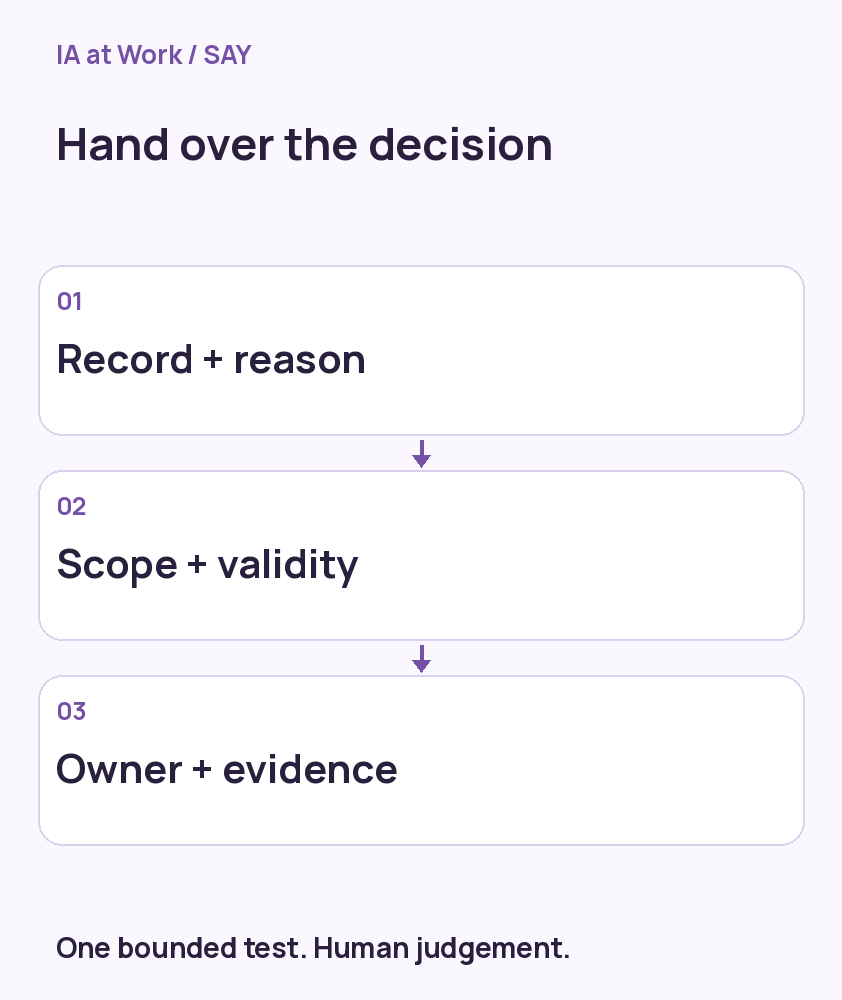
When closing the file, ask its owner what a replacement would need: the decision, its rationale, scope and expiry. Add the supporting record and the responsible person. A few precise sentences are more useful than a full meeting transcript nobody reviews.
An assistant can propose the note from authorised records. The person who knows the case confirms or corrects it, including saying that the reason is unknown. A plausible inference does not become a fact because AI has phrased it neatly.
Retrieval is not permission to reuse
Search needs to distinguish the standard rule from an exception and expose conflicting references. A new price list may supersede the old one without cancelling a signed commitment. A useful answer explains which reference applies now rather than returning the first similar passage.
Keep the original access restrictions. A handover note must not expose margins or personal information to the whole company. Access controls belong in the document service and application; a cautionary sentence in a prompt is not a substitute.
The test: hand over an actual case
Choose a closed case and ask an authorised colleague who did not handle it to prepare the next reply. Can they find the decision, check its evidence and identify what remains unknown without calling the original owner? Compare search time and necessary corrections, not just summary quality.
When they get something wrong, identify the cause: a missing note, wrong customer relationship, outdated reference or misunderstood rule. Fix that cause before adding more documents. A larger memory will not supply missing accountability.
SAY Digital can scope that first handover: one decision type, authorised sources, a note format and a test with your team. That establishes whether you need better filing, connected business memory or a focused AI assistant.
SAY Go Big Online — discuss your first use case
Continue exploring this case
- Stop renting your chatbot’s memory: keep your business context
- Business automation: recover from an error without creating duplicates
References and limitations
These references explain mechanisms and risks. The situations are illustrative; no quantified client benefit is claimed.