

Your AI waits for instructions. What if it knew when to act?
Your AI waits for instructions. What if it knew when to act?
A customer reports a blocker in a discussion thread. Your chatbot could help resolve it. But it waits for someone to open a conversation, find the case and ask the right question. Your team still has to connect the signal to the work.
Proactive AI changes that starting point: an authorised event can initiate work without a fresh instruction at every step. It identifies what deserves attention, prepares the case and brings you the decisions that belong to you. That takes more than a smarter model. It takes an organisation that lets the system recognise when to act.
No time to read? Get the essentials in video. — Audio in French; French captions.
DeepSeek’s signal is about organisation, not another tool list
On 1 November 2026, DeepSeek published Exploring Super-agent Design: Towards a More Autonomous Agent System. It explores an architecture for an agent that works over time, handles several tasks and responds to events in its environment. It is not an announcement of existing DeepSeek Harness features.
The proposal centres on four characteristics: continuous interaction across channels, productive parallel work, proactive responses to relevant events and persistent operation despite incidents. Together, they shift the burden of managing sessions and follow-up from the user to the system.
The official Harness preview and its MIT-licensed code provide a concrete starting point. The Super-agent prototype implements only parts of the ideas and is not a finished official product. For a business, the useful question is not “what should we install next?” but “which responsibilities must an AI system be able to carry?”
One point of contact stays available while Workers get on with the job
Imagine a project waiting for missing information just as another customer request arrives. A single conversation that does everything can become a queue. Entirely separate conversations create the opposite problem: your team has to remember every case and join the results together.
The proposed architecture separates those responsibilities. A Router provides long-lived coordination, handles human interaction and dispatches tasks. It does not execute them itself. Workers do the work in isolated contexts, each with its task, sources and authorised tools. They report status to the coordinator, which keeps the response to the user coherent.
In our example, one Worker can collect the missing project material while another prepares a reply to the new customer. The point of contact remains available. Context isolation avoids automatically mixing task details; it does not remove the need for permissions on data and shared workspaces.
Useful initiative starts with a filter
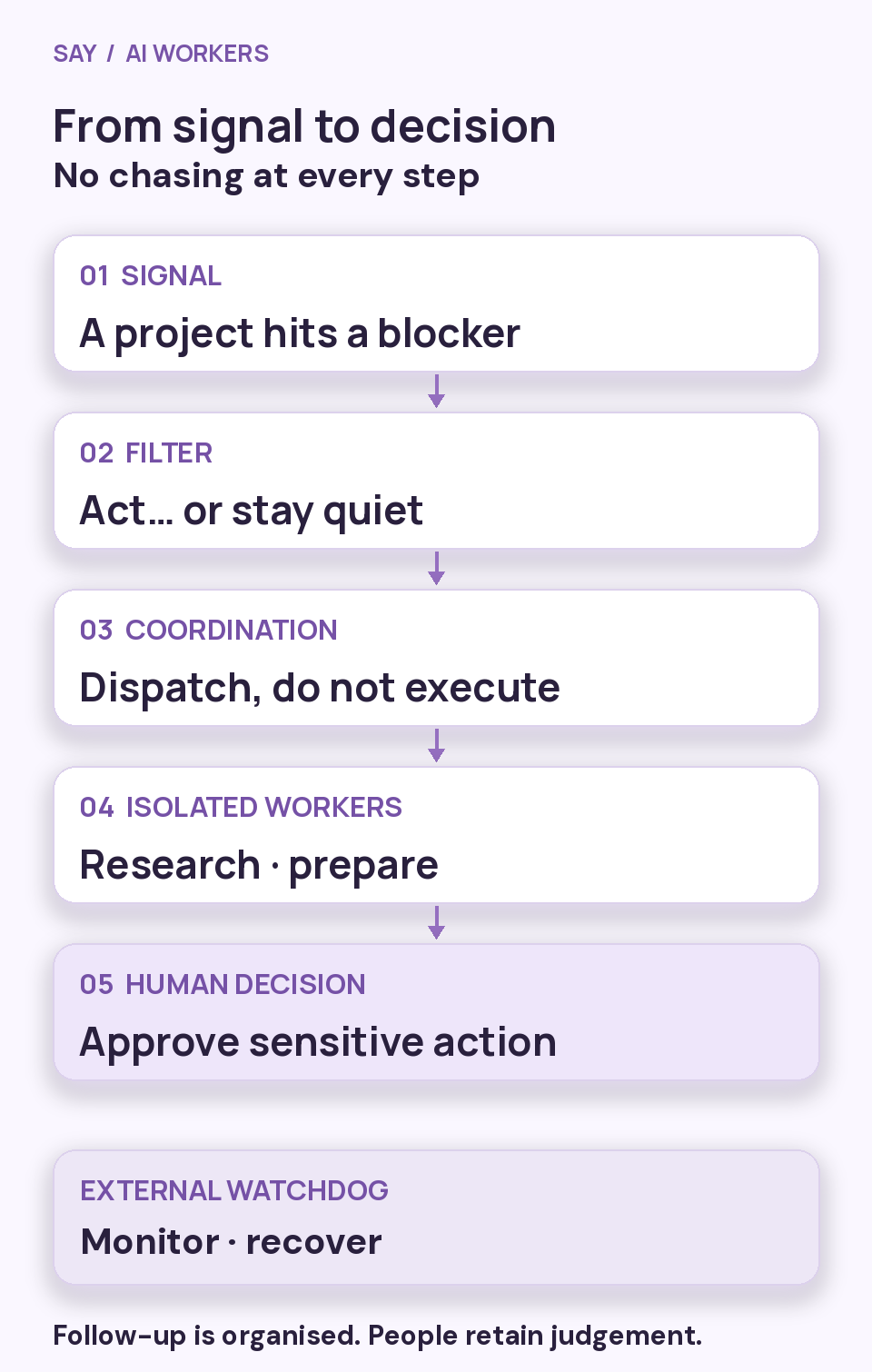
Being proactive does not mean replying to every message. An event first passes simple rules: an authorised source, a relevant case, a duplicate or a notification that needs no follow-up. Candidates requiring an understanding of meaning then go to the model. Staying quiet is a normal system decision.
If a blocker deserves attention, the coordinator assigns the work. Later messages in the same thread can go directly to its subscribed Worker, without redistributing every detail. A change in scope returns to the coordinator. This makes it possible to follow a case rather than start another conversation.
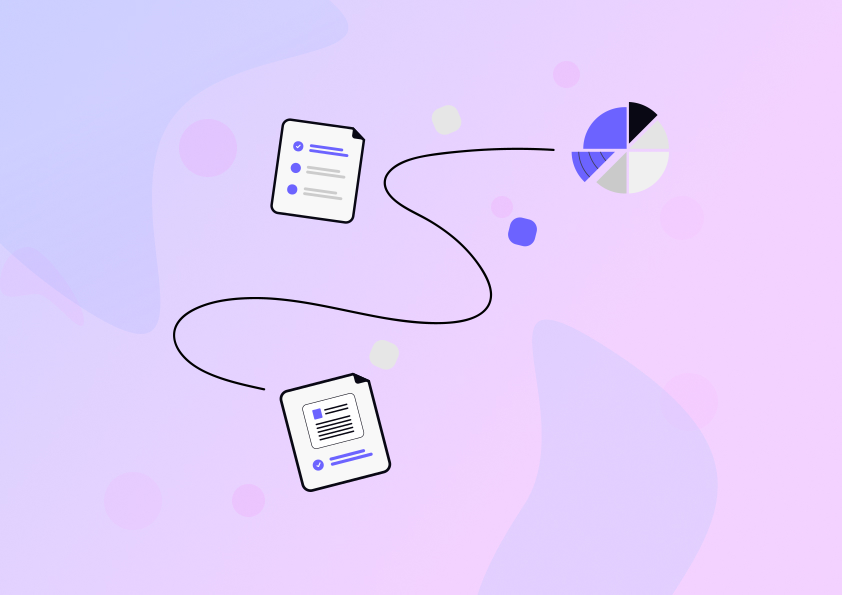
The workflow below connects a useful signal to prepared work and then a human decision. Technical monitoring sits alongside that chain; it does not replace the decision-maker.
Preparing a decision is different from making it for you
Return to the blocked project. In this illustrative scenario, the Worker finds the request, compares the available material and prepares a precise question for the project owner. It can proceed with authorised internal research. Changing a customer commitment, sending a sensitive reply or spending money requires a predefined authority boundary and approval whenever the rule demands it.
That division must be enforced through system permissions and controls, not merely requested in a prompt. The company must also decide what information Workers may share and what may leave the business. DeepSeek treats security, privacy and context sharing as open questions: the architecture alone does not settle governance.
Follow-up has to survive an interruption
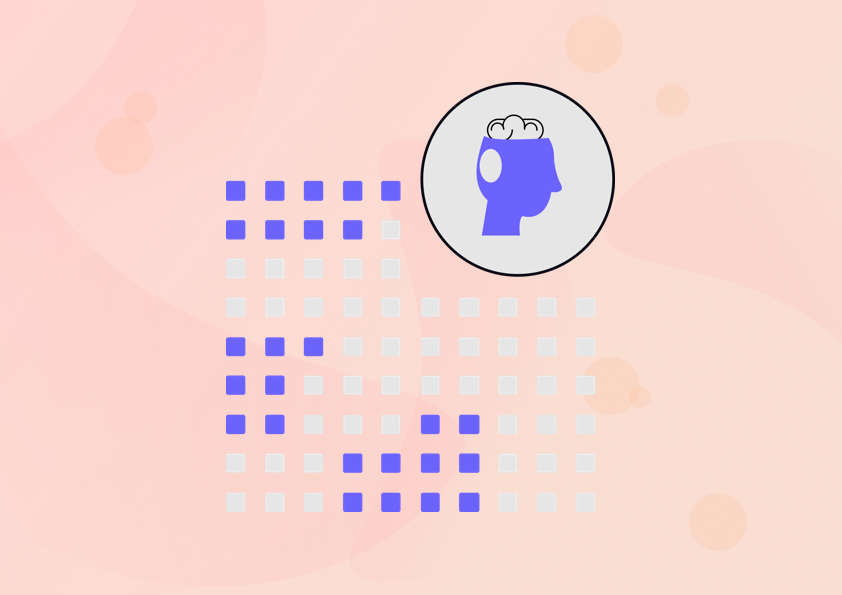
An agent that promises to follow a case and disappears at the first failure creates another job for the team. The proposed approach separates compute, retained state and working environments. An external Watchdog monitors service health and can initiate technical recovery. It does not, on its own, establish that a business answer is correct or replace human approval.
Persistence has running costs: hosting, model calls, integrations, logging and maintenance. Open code does not mean free operation. Nor do the publication’s synthetic coding experiments, which use mocked components, measure the benefits for your business.
Your business intelligence needs a trigger as well as a memory
We previously explained three pillars for keeping your business context: lasting knowledge, current data and capabilities for action. The next step is to connect that base to useful events, clear ownership of follow-up and limits on intervention.
Keeping context outside the model makes your business knowledge easier to retain, but switching providers still requires integration changes and testing. Your own intelligence takes shape in those connections: understanding a signal, finding the right references, preparing work and knowing who must make a decision.
Start with one case that too often waits for someone to chase it. Define the signal that should wake the system, what it may read, the result it should prepare, who approves and when it must escalate. Test an irrelevant signal, missing data and an interruption too: knowing when to stay quiet or resume cleanly is part of the job.
At SAY, that is the role we aim to build for an AI Worker around your work: less manual chasing, preparation you can check and human decisions at the right points. The question moves beyond “what can I ask my AI?” to “what useful work should it know to start, and how far may it go?”
Sources
- DeepSeek, Exploring Super-agent Design, 1 November 2026 — architectural ideas and synthetic experiments.
- DeepSeek Harness official preview and MIT repository.
- Partial Super-agent prototype — distinct from a finished product.