
Supabase for development teams: planning application data and access controls
Supabase combines a Postgres database, authentication, file storage and services such as Realtime and server functions. You can use it as the foundation for a portal, business application or SaaS product without assembling every service separately. Postgres provides relational structures, constraints and SQL queries. However, an integrated platform does not replace product design, security checks or daily operations. Your application still needs explicit rules about what information each person can access.
Short on time? Watch the article essentials.
French audio · English captions.
Who is it for?
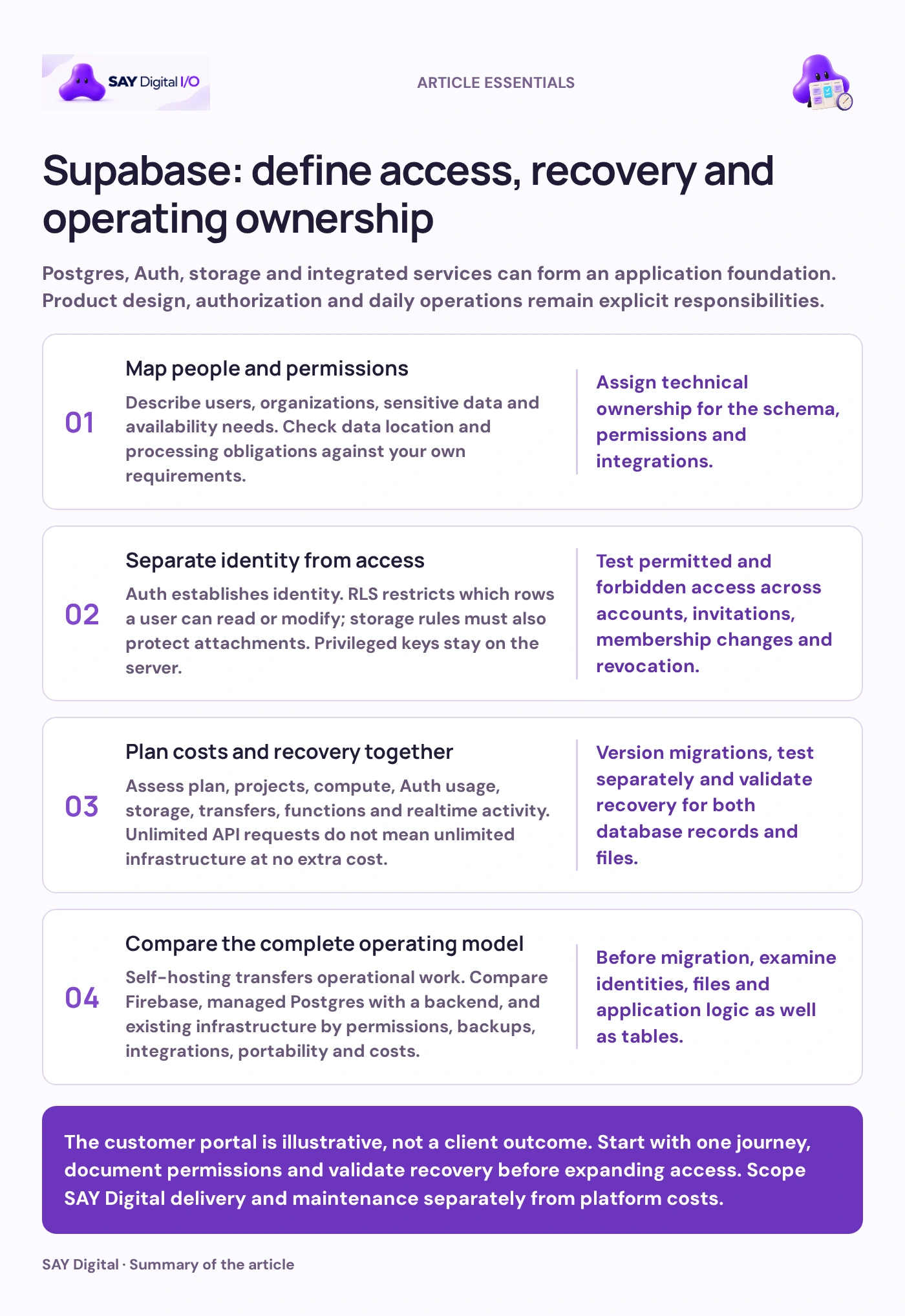
Supabase is worth evaluating when your team builds an application with identified users and relational data. It is more suitable for an organization that can maintain its schema, permissions and integrations than a project without technical ownership. Before choosing it, describe your users, their permissions, sensitive information and availability requirements. Check data location and processing obligations against your own requirements rather than assuming the platform automatically meets them.
What SAY Digital can deliver
SAY Digital can scope your architecture, model Postgres tables and connect your interface to the required services. Work can include Auth, login journeys, Row Level Security policies and file access. Authentication establishes identity; it does not authorize every operation. RLS policies should restrict which rows a user can read or modify according to their identity and organization. Include tests between separate accounts, versioned migrations and recovery documentation in the implementation scope.
When to choose Supabase, and when to avoid it
Consider this approach when you want a relational foundation with integrated services and can design the business rules. Avoid treating a connected prototype as a secure production application. Privileged keys belong on the server, never in the browser. Specific networking, compliance or operational requirements may justify a different architecture. Self-hosting is another option to assess, but it transfers operational work rather than eliminating maintenance or security responsibilities.
Illustrative example
Imagine a portal where your customers upload documents and track requests. Auth handles login, while Postgres links users, organizations and cases. RLS policies must prevent one customer from reading another customer's cases, and storage access rules must protect attachments. An administrator receives explicitly defined permissions. This is an illustrative scenario, not a customer outcome. Test invitations, changes in organization membership and revoked access before opening the portal to users.
Open the full-size infographic ↗
Project costs and operations
Your budget includes the Supabase plan, the number of projects and their compute resources. Usage also matters: active users for Auth, database and file storage, outgoing transfers, functions and realtime activity where applicable. Included allowances, credits and optional features depend on the selected plan. Consult the official pricing page before committing and account for a separate testing environment. Unlimited API requests should not be interpreted as unlimited infrastructure or usage at no additional cost.
SAY Digital services require separate scoping for discovery, implementation, testing, migration, documentation and maintenance. Define a backup strategy appropriate to your plan and test recovery for both database records and files. Version SQL migrations, validate changes outside production and prepare a recovery procedure for failed deployments. Monitor consumption and assign ownership of alerts. No price, savings or delivery outcome is guaranteed here; a meaningful estimate requires volumes, requirements and responsibilities.
Alternatives to compare
Compare Firebase when a document-oriented approach fits your model, managed Postgres with a dedicated backend when you want to separate services, or your existing infrastructure when it already meets the need. Apply the same criteria to each option: permissions, backups, integrations, portability and operating cost. Exporting tables alone does not migrate identities, files and application logic. Examine those dependencies before treating a platform change as straightforward.
FAQ
Does Supabase replace your developer?
No. You still need to design data structures, verify authorization and maintain the application, even when services are integrated.
Does signing in protect every record?
No. Validate RLS policies and storage rules with tests covering both permitted and forbidden access across different accounts.
How can you start cautiously?
Limit the prototype to one journey, document permissions and validate recovery before expanding the scope or inviting more users.
Scope your next step
Talk to a SAY Digital expert to examine your application, dependencies and conditions for an initial deployment.