OpenAI Codex for developers: preparing code changes for testing and review
OpenAI Codex supports work on software projects: understanding a codebase, proposing a feature, examining changes or investigating a fix. Official documentation lists a command line interface, an extension for development environments and Codex Cloud. Your context, instructions and granted access determine what the tool can accomplish. A plausible proposal does not establish correctness or compatibility with your architecture. Treat generated changes as work to evaluate, not as an automatic production approval.
Short on time? Watch the article essentials.
French audio · English captions.
Who is it for?
Codex is relevant to developers, technical leads and product teams with someone who can review code. You can evaluate it on an existing application or a clearly bounded prototype. Without a technical owner, avoid treating the result as immediately operational software. Identify your repository, dependencies, permitted information and acceptance criteria before assigning the first task. Someone should remain accountable for deciding whether the result meets your actual requirements.
What SAY Digital can deliver
SAY Digital can help you select a use case, prepare project instructions and organize an initial trial. Your engagement can include an application integration, a focused fix, automated tests and handover documentation. The scope defines responsibilities, access and expected validation. This support does not replace your technical governance or guarantee regulatory compliance. Agree on deliverables and exclusions before work starts, particularly when existing systems or external services are involved.
When to choose Codex, and when to avoid it
Consider a trial when your task is explicit, your code is version controlled and the outcome can be verified. A limited fix or additional tests lets you compare changes against concrete expectations. Avoid autonomous production changes when their consequences are difficult to reverse. Secrets, sensitive information and broad permissions require prior assessment. Restrict access to what the task needs and retain human approval for sensitive actions rather than removing safeguards for convenience.
Illustrative example: fixing a form
Your team wants to correct form validation that accepts inconsistent dates. You could ask Codex to locate the relevant logic, propose a correction and add regression tests. A developer then examines the diff, runs the tests and checks edge cases. This is an illustrative scenario, not a customer case or an observed result. A prototype validates an approach; production also requires monitoring, a rollback procedure and a named maintenance owner.
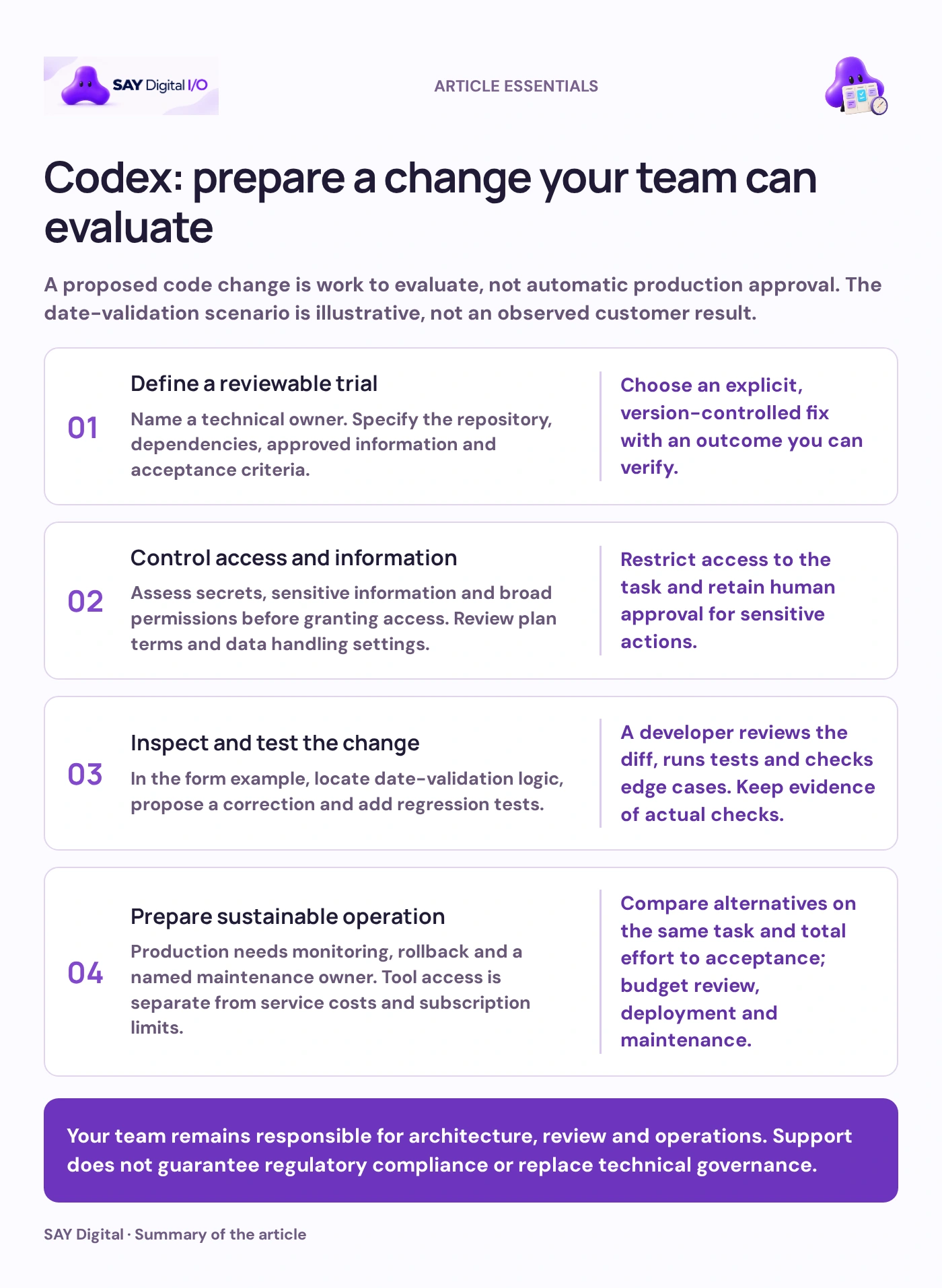
Open the full-size infographic ↗
Costs, subscriptions and usage rights
Separate access to Codex, the limits of your subscription and SAY Digital services. Check current offers, available features, quotas and possible additional purchases before committing. A subscription does not mean every use is unlimited; do not assume access to one product covers every associated consumption charge. Review the applicable contractual terms, rights to supplied materials and dependency licences. Budget discovery, development, review, testing, deployment and maintenance separately. A meaningful services quotation needs a defined scope and responsibilities.
Alternatives to compare
Compare Codex with GitHub Copilot, Claude Code or conventional development without an agent. Your existing environment and team capabilities may favour another approach. Test options on the same task with the same security, readability and validation requirements. Compare the total effort needed to reach an accepted change rather than generation speed alone. No tool removes the need to understand your system, maintain dependencies or support the software after delivery.
FAQ
Does Codex replace your developer?
No. Your team remains responsible for architecture, review and operations. A convincing answer can still contain a subtle error that affects real users.
Can you use confidential code?
Check your plan’s terms, data handling settings and internal authorization. Do not share secrets by default, and limit the context to approved information.
How do you move from prototype to production?
Set acceptance criteria, inspect permissions, run tests and plan a reversible deployment with a named owner. Keep evidence of the checks actually performed.
Scope your next step
Talk to a SAY Digital expert to clarify your requirements, constraints and the conditions for a useful initial trial.