Hermes Agent and n8n for founders who need a reliable order handover
A customer has confirmed a booking, but the workshop venue is still missing. Create the workshop tasks immediately and your team inherits an incomplete brief. Wait for the founder to check every detail and the work stays in your inbox.
Start by evaluating n8n when the job follows a repeatable path across applications. Consider Hermes Agent when preparing the handover means working through changing requests and documents. You can also combine them. This is not a contest between rigid automation and intelligence: n8n supports AI agents, tools and memory too.
This is a decision guide based on official documentation reviewed on 15 November 2026, not a production benchmark. The useful question is which arrangement you can keep running when an order does not fit the usual pattern.
Short on time? Watch the article essentials.
French audio · English captions.
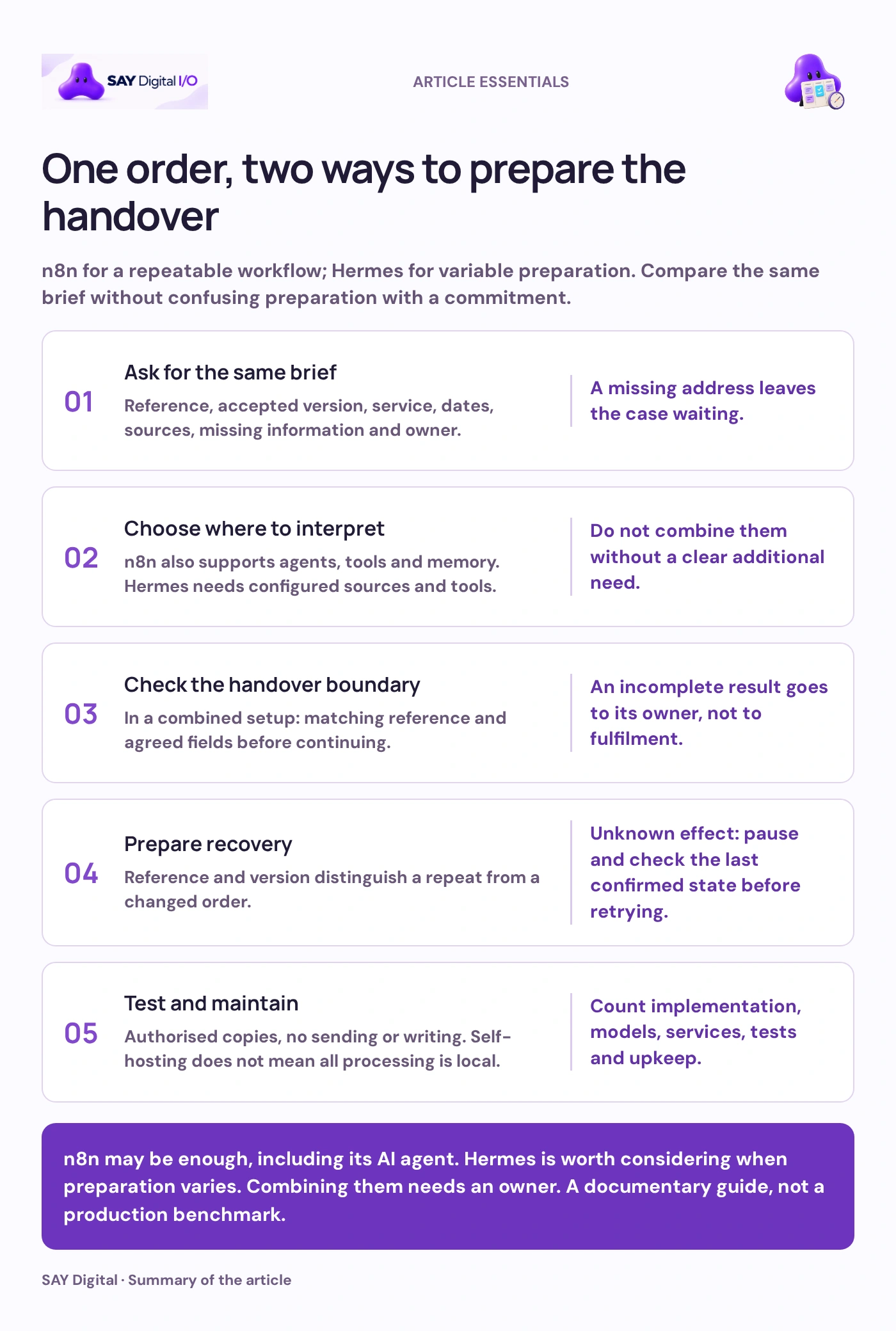
Open the full infographic ↗
Give both options the same handover to prepare
Imagine a small business delivering a workshop at a customer's premises. The customer has accepted the order but has not supplied the venue address. Ask both options for the same handover: order reference, accepted version, service and quantity, requested date, confirmed date, source documents, missing information and the person responsible for the next step.
A useful handover might read: “Order accepted; venue address missing. Status: waiting. Account owner to obtain the address; question drafted, not sent. Scheduling remains with the workshop coordinator.” It should not turn a requested date into a commitment. Preparing the paperwork does not confirm the session; the workshop coordinator decides whether it can enter the schedule.
A shared deliverable makes omissions and necessary corrections visible. A polished paragraph alone does not tell you whether the next person has enough information to act.
n8n: define the route each accepted order should take
A workflow in n8n is a set of connected nodes: steps that receive, check, transform or pass on information. For this order, you could define an incoming event, look up the matching order, check its fields and prepare the handover. A missing-address branch would send the case to the account owner.
You would need to build and test that route using the access your applications provide. A listed connector does not prove that the exact operation you need is available. When the steps recur and the exceptions can be described, n8n is a sensible starting point.
Some steps may require interpreting free text. n8n's AI Agent node connects a language model to tools the agent can choose to call; its AI workflows can also include memory. You may therefore handle interpretation inside n8n without adding Hermes. Part of the decision is where you want that interpretation to be defined and maintained.
The n8n guide to uses and tradeoffs covers the platform and architecture choices. This comparison is about who prepares the handover and how you keep responsibility clear, rather than how to build the workflow.
Hermes Agent: delegate preparation when the inputs change
Hermes Agent combines a model, tools, persistent memory and reusable procedures called skills. Its documentation also describes scheduled tasks. A proposed setup could prepare the same handover from an authorised order file and customer correspondence, then explain what needs clarification before it is passed on.
That is worth evaluating when the relevant documents and questions vary between customers. Hermes does not acquire your catalogue, commitments or business-system access simply because you install it. Someone must define usable sources, connect the required tools and check which actions are actually available.
Its memory is bounded and scoped to the agent's profile. It is not an order register or an automatic Company Brain: organised, maintained business knowledge requires separate work. The Hermes Agent business guide explains those components. Here, the test remains whether the next person receives a usable handover.
A combined setup still needs one owner for each order
One possible design would have n8n receive the order and check stable fields, then ask Hermes to prepare a summary when the documents require a more open-ended reading. n8n would resume with an agreed result. That connection has to be implemented; owning both products does not establish a working integration.
For this booking, the result from Hermes should separate the order reference, consulted sources, missing address, proposed question and waiting status. Before continuing, the workflow would check that the reference matches the incoming order and the expected fields are present. An incomplete result would go to the responsible person without creating fulfilment tasks. That boundary needs an agreed design and tests; a convincing summary is not enough.
Now consider a repeated event. The setup should find the existing case rather than create a second workshop task. Use the order reference and accepted version to define a repeat, as distinct from a changed order requiring review. Neither an agent’s memory nor a workflow diagram proves that it will do this. Duplicate handling needs its own design and test.
A harder case is an application timing out after a create request: the task may already exist. Check the last confirmed state before trying again. If the effect is still unknown, pause recovery and have the owner inspect the application. Every extra connection needs somewhere to make that check.
Who can recover the work when you are unavailable?
n8n Cloud handles service hosting, updates and infrastructure. Your business rules, application connections and application-related incidents still need an owner. Self-hosting adds responsibility for running the instance; features vary by plan and edition.
Hermes also needs someone to maintain its configuration, access, procedures and sources. Hosting the agent on your own machine does not mean all processing stays there: connected models and services may be external. The same applies to a self-hosted n8n instance calling an AI provider.
Include software access, any hosting, model and service usage, implementation, tests, documentation and upkeep in the comparison. Do not compare a Community edition's licence cost with the full cost of an assisted deployment.
Check execution and concurrency limits and the features of your chosen n8n plan, as well as model access: a chat subscription does not necessarily include API access. For a solo founder, having time to diagnose a failed handover matters as much as the initial budget.
Leave a short recovery note: where the latest case is stored, what has already happened, how to stop processing, what to check before retrying and who covers for you. If nobody can maintain that record and handle exceptions, an explicit manual handover is preferable to a combined setup only you understand.
Test a complete order, a missing address, a repeat and denied access
For the first trial, use authorised copies without writing to business applications or sending anything to the customer. Ask both options for the same handover, with the clarification question kept as a draft. Start with a complete order, remove its address, then submit the same event again. Check whether the result retains source references, separates requested and confirmed dates, assigns the missing information and recognises the repeat.
This document-only trial does not prove duplicate prevention in your applications: a separate integration trial must check actual effects and recovery.
Also try denied access. A useful result is then a waiting case with an identified owner, not invented information. Record setup work and the corrections a person has to make. A demonstration alone cannot establish savings.
Choose n8n when the route is stable enough to describe and hand over to someone else. Evaluate Hermes when variable preparation is the work you need to delegate. Keep a combined design only if it adds something beyond an agent inside n8n and someone can maintain the connection.
For the capabilities discussed here, see n8n’s documentation on AI workflows and Cloud versus self-hosting, alongside the Hermes pages on persistent memory and scheduled tasks. These describe capabilities and conditions, not a validated implementation for your booking.
Bring the order problem to SAY, not a shopping list of tools
If you need to connect company knowledge to a few recurring workflows, start by describing your AI project to SAY, then create your account to continue with a human conversation before any purchase. First Contact is available on a tailored quote: a Brain, a few workflows and an agent team whose composition is defined in the quote. Bring a recent order and its awkward exception so the discussion starts with the handover you need and the person who will check it.