

An AI assistant that helps your customers choose without taking over
A shopper opens two product pages, returns to the first and checks delivery information. Should your store offer help? Perhaps. They may simply be comparing their options. An e-commerce AI assistant should address a recognisable difficulty, not turn every pause into a conversation.
Start by separating three situations: information that should be visible to everyone; a question that needs tailored advice; and a customer who has chosen a product and is ready to buy. Making that distinction stops you paying for an assistant to cover up problems with the website.
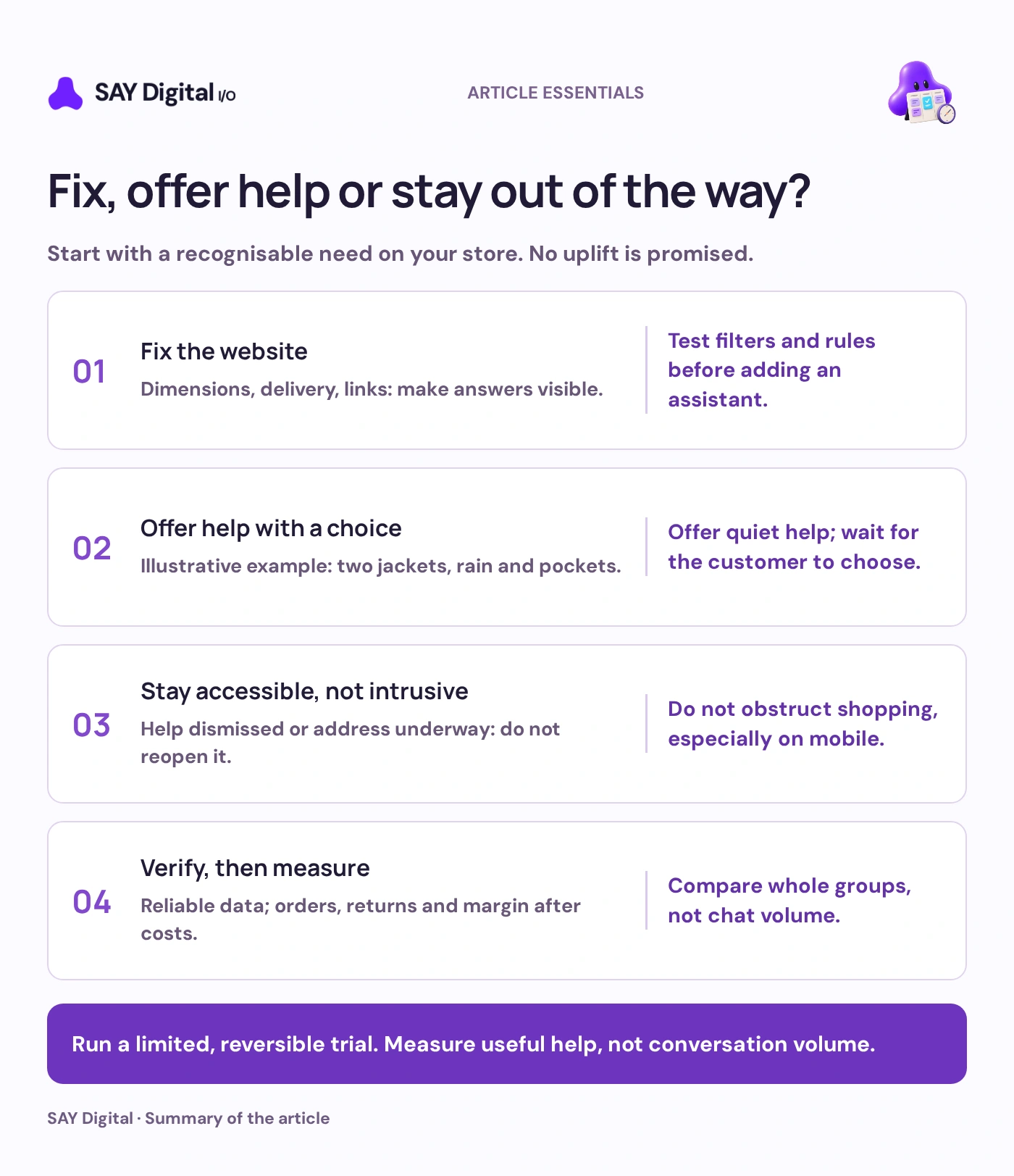
Open the full-size infographic ↗
Short on time? Watch the article essentials.
French audio · English captions. Infographic in English.
Fix information the website should already provide
If customers keep looking for a cabinet’s dimensions, put them on the product page. If shipping charges appear only at the last step, explain how they are calculated earlier. Fix broken links and provide useful replacement pages. Generated answers are not a substitute for those repairs.
An assistant makes more sense when a request combines several constraints: “A running jacket for wet weather, with zipped pockets and a limited budget.” It can check those requirements against product details, ask about the budget and explain the differences. Rain protection and pocket fastenings need to be documented: sales copy is not enough to establish a missing specification.
Offer help when the need is clear enough
Imagine a customer comparing two running jackets. A link labelled “Compare rain protection and pockets” lets them open a comparison while keeping the product in view. The invitation tells them what they will get, and they can ignore it.
Browsing signals are ambiguous. Time on a page might mean careful reading or a phone left on a desk. Switching between products might mean comparison rather than confusion. Start with a quiet, dismissible offer. Wait for the customer to ask a question or choose the help before starting a conversation.
A precise search should return products straight away. A request requiring advice may benefit from a guided choice. For recurring requests, check what filters and search rules can already do before adding an AI assistant.
Know when to stay out of the way
Once someone dismisses the help, do not bring it back on every page. If they have chosen a product and are entering their address, avoid opening a conversation over the form. Keep assistance available when they ask for it.
On a phone, even a small window can take up much of the screen. Check that customers can dismiss it, resume shopping and use the controls without obstruction. Test keyboard and screen-reader navigation too: closing the help should let them return to the product or field they were using.
An answer is only as useful as the information behind it
Even unobtrusive help can lead to a poor purchase if its information is incomplete. The assistant needs product specifications, availability, delivery rules and return conditions relevant to the request. A jacket available in a different size does not solve the problem. A typical delivery time is not a promise that it will arrive before Friday.
If the date cannot be confirmed, the assistant should explain what is known and offer to contact the support team. It must not invent stock or offer an unauthorised discount. Assign an owner for product details and policies, and decide how availability will be checked. For this first product-advice trial, leave order changes in the store’s existing process.
Measure useful help, not conversation volume
Before the test, define the problem, who is eligible for help and what counts as a confirmed order. Then record test assignment, help offered, help opened and purchases. Those steps show where customers use or ignore the assistant; they do not establish that it generates additional sales.
Where traffic allows, randomly assign eligible visitors to a version offering help or a version without that offer. Compare orders across everyone assigned to each group, not just those who opened the assistant: those shoppers may already have been more likely to buy.
Track cancellations and returns, then assess the margin left after integration, running, maintenance and support costs. Review dismissals and incorrect advice as well. More conversations may mean the answers are not resolving anything.
A promotion, a stock change or too few purchases can make the comparison hard to interpret. A before-and-after difference alone does not demonstrate a conversion uplift. Decide before launch what would justify keeping the assistant, revising its answers or pausing it. An incorrect delivery promise needs attention without waiting for the test to finish.
Choose a first trial you can stop
Pick a well-documented product range and a common question. Decide when to offer help, when to leave it available without intervening, and who takes over when the assistant cannot answer. Test the mobile journey and make sure you can disable the assistant without stopping purchases.
If product pages and internal routines need work first, the e-commerce mini case on catalogue and operations helps scope that work. For purchases made inside an external AI interface, see the catalogue and order checks for agentic commerce. That is a separate sales channel, not assistance within your store.
Start with one buying question your customers struggle to answer. Tell SAY Digital about your shopping journey to discuss whether it needs a website fix or a focused assistance trial.