

AI can write ten posts about your profession. It cannot decide what is worth saying on your behalf. The advice you give against the grain, the detail you always check, the method you stopped using: that is where AI-assisted personal branding begins. In your work, before it reaches the page.
A prospective client wants more than someone who knows the subject. They want to understand how you approach it. Four content types — educational, inspiring, personal and proof — make that difference visible. Think of them as four ways to show your expertise, rather than four slots in a publishing calendar.
Type, topic and format are separate decisions
The topic is what you discuss. The type is what the reader gets from the piece. The format is how you present it: a text post, video, carousel or interview.
The distinction matters before you start writing. Turning a list of tips into a carousel gives it a different layout, not a different angle. Explaining why you chose one method over another changes what people learn about you. Decide what you want to show them first. Choose the format afterwards.
This framework, informed in part by a reel by Myriam Fernandes (@myriam__fernandes), helps you make that choice. Its value lies in the range of perspectives, not an equal split between content types.
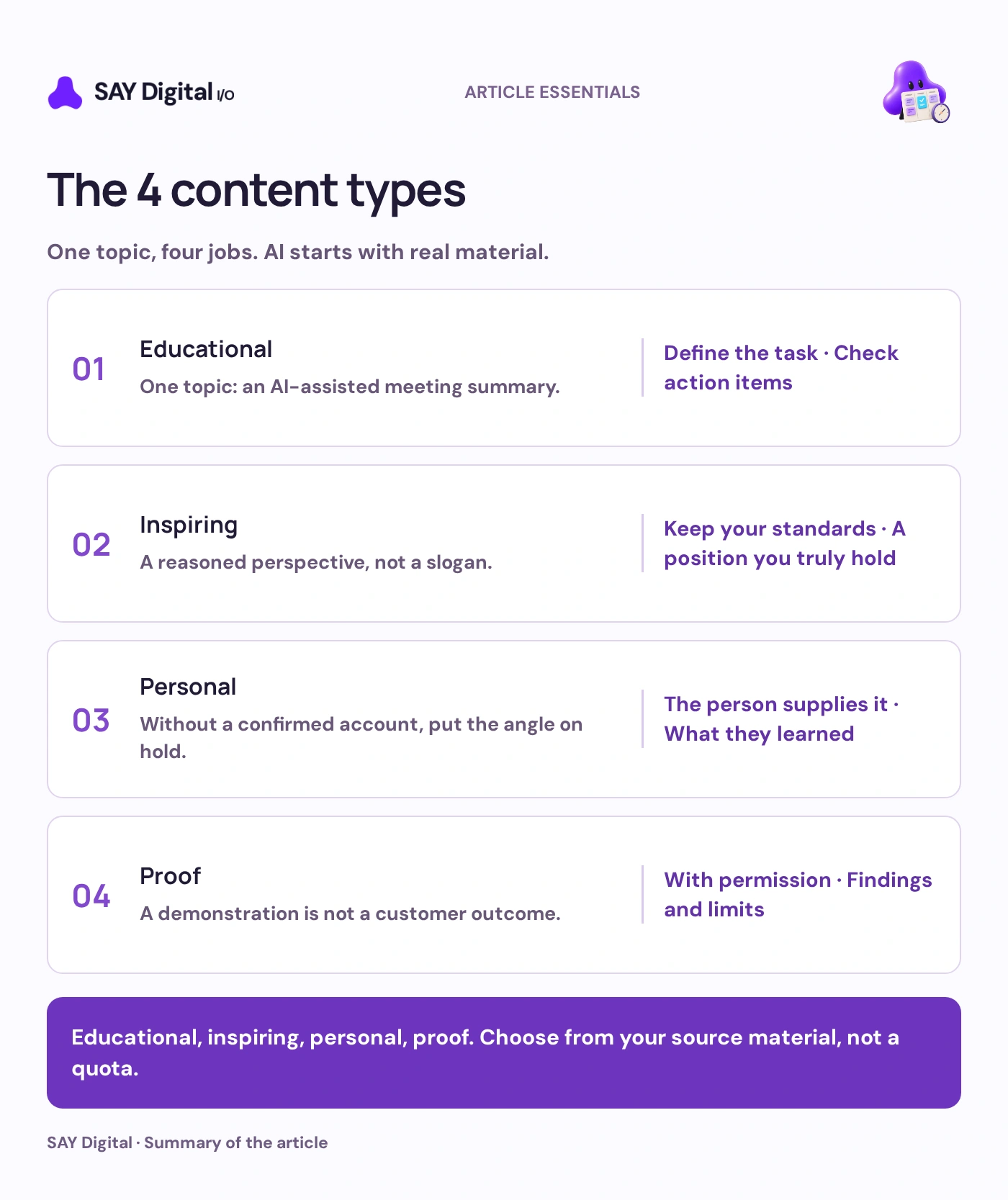
Open the full-size infographic ↗
Short on time? Watch the article essentials.
French audio · English captions. Infographic in English.
One topic, four genuinely different pieces
Take one specific topic: delegating a first meeting summary to AI. Here are four possible editorial approaches. The subject stays the same; what the reader sees of your expertise changes.
Educational: teach a useful skill
“Before asking AI for a meeting summary, specify these three things.” Use that opening to explain the output you need, the source document and the final check. Request a list of decisions and actions, then compare owners and deadlines with the original meeting record.
The value is in the practical detail. Where should the reader look? What should they compare? When should they step in? Give them enough to try your method, rather than simply agree with your advice.
Inspiring: make the case for a different perspective
“Knowing what a good summary looks like matters more than finding the perfect prompt.” This angle shifts attention from the tool to professional judgment. You could argue that a decision traceable to its source is worth more than polished prose nobody knows how to check.
The inspiration comes from a conviction and what follows from it. Why does that standard matter to you? What would it change for a team? A point of view becomes interesting when you follow the argument through.
Personal: explain a change in how you work
Go back to a meeting, a delegated task or a review you remember clearly. What did you expect from the summary? Which detail made you rethink how you requested or checked it? Tell that story, then explain the decision it led you to make.
Your experience supplies this angle. A working habit can reveal a great deal: why you always return to the decisions before improving the prose, for instance. Personal content makes your judgment easier to understand. It does not require turning your private life into material.
Proof: let people inspect the work
Show the instruction, a source excerpt, the resulting summary and your review. Readers can follow the checks: find an action, compare a deadline, trace a decision back to the record. Your method becomes visible.
A real case shows what happened in its particular context. A clearly labelled demonstration shows how you work. Choose material you can share, explain your contribution and be specific about the result. Evidence earns its weight from what people can examine, not the adjectives attached to it.
Give AI source material, then ask it to help
Give AI more than a topic. A voice note explaining a choice, questions from client meetings, an annotated method or a demonstration gives it something to work with. Your point of view often appears in an aside: “I do that differently, and here is why.”
AI can find a thread, suggest angles, arrange an argument and tighten a draft. You decide which ideas deserve your name. A short voice profile — your audience, your vocabulary and a few pieces you have approved — helps it write without flattening your voice.
A prompt to start with: “Here are my notes. Suggest four angles: educational, inspiring, personal and proof. For each, explain what readers will learn about my work and identify the source material you are using. If something is missing, ask me a question. Do not invent experience, opinions or results. Then develop the angle I choose.”
Read the argument before polishing the sentences. Is this what you think? Is the telling detail still there? Have you checked the facts and whether the documents can be shared? That is the editorial work: deciding what you mean, not just how smoothly it reads.
Feed AI your experience, not just your topic
Ask AI for a post about management and it will readily give you advice that anyone could put their name to.
Instead, give it the reasons you turned down a project, a method you abandoned after several attempts, or the objections your clients keep raising. Now you have something to build a position on.
That is the value of a second brain: finding this material when it is time to write. Your notes, conversations and decisions become the starting point for your content. AI can connect two experiences, bring a conviction into focus or ask you to explain a choice.
You still need to decide what is worth sharing. An archive does not make a voice. But it lets you work from your own experience rather than an average answer about your profession.
Connect expertise to a useful enquiry
A useful piece lets someone think: “I can see how this person would approach my problem.” Educational content offers a glimpse of your method. Inspiring content reveals your priorities. Personal content explains where they came from. Proof lets people examine the work. These functions complement one another without prescribing a reading order.
Make the next step easy to understand: a page explaining the relevant service, a clear contact link and a question the reader can answer. When someone gets in touch, ask what prompted them. Was it a method, a decision you explained or a case that felt familiar? Those answers tell you more about the quality of your presence than a reaction count on its own.
Track attention, qualified enquiries and opportunities separately. This helps you understand how content contributes to a relationship without crediting every sale to the last post someone read. Choose a pace that still leaves you with something useful to say.
Three recommendations for your first series
- Start with a problem you know well. Choose a question that comes up in your work. For each angle, finish the sentence: “After reading this, people will understand that…” If the answers are identical, change the angle.
- Gather the material before writing the hooks. An explanation, a choice you can defend, a specific memory, a document you can share: see what you have. You do not need all four types in every series.
- Read the draft aloud. Rework anything that sounds wrong, check the facts and keep the details that carry your reasoning. After publication, note the questions the piece prompts. They are material for what comes next.
Build a presence you can stand behind
The easier writing becomes, the more your choice of what to say matters. A decision explained, a precise observation, a different way to frame a problem: these give people a reason to pay attention. AI can help give them shape. Your work gives them weight.
Keep a working record of those notes, questions, decisions and examples, including the context and reasons behind each choice. Your next piece will start with something richer than a blank page. To build that presence with SAY Digital, start with your audience, the material you already have and the conversations you want to open. Tell SAY Digital about your project (the enquiry form is in French).