



Build sales follow-up that keeps opportunities moving
Build sales follow-up that keeps opportunities moving
A quote has gone out and a meeting has taken place, then the opportunity disappears between an inbox and your CRM. At the next sales review, everyone tries to remember who was supposed to get back in touch. The problem is not always a lack of follow-up messages. It is the absence of an explicit next step tied to the latest actual exchange.
Sales follow-up that keeps opportunities moving starts with a list where every row can be acted on. You will connect an opportunity, its last commitment, a named owner and a dated next action. Your AI Worker can prepare that handover without acquiring permission to send messages or make commitments on your behalf.
No time to read? Get the essentials in video. — Audio in French; on-screen text in French.
1. Identify one opportunity before scheduling a follow-up
Choose a small set of open opportunities you are authorised to access. For each one, match the contact, company, request and CRM identifier. One person may be discussing two separate projects; two records may also describe the same opportunity. A shared email address is not sufficient evidence to merge records.
Flag potential duplicates for human review. Keep the references to the original exchanges and do not delete records based on a resemblance. Only one row should carry the approved action for a given opportunity, or two salespeople may prepare incompatible follow-ups. Twenty CRM: from meeting notes to the next sales action explores how to turn an exchange into a usable opportunity record.
2. Start from the last commitment, not the oldest reminder
Read the customer’s latest reply and the exchange it responds to. Separate what your team promised from what the customer accepted. “I will send the documents on Thursday” calls for a different action from “Contact us after our committee meeting.” Record the date, author, source link and relevant wording. Silence is neither agreement nor rejection.
Write a specific next action: prepare a requested comparison, check a missing document or suggest a meeting after the agreed date. Name the owner and the review date. If no date was agreed, the owner can set an internal review date, but must not present it as a customer commitment. If meeting notes conflict with a later message, flag the disagreement rather than silently selecting the convenient version.
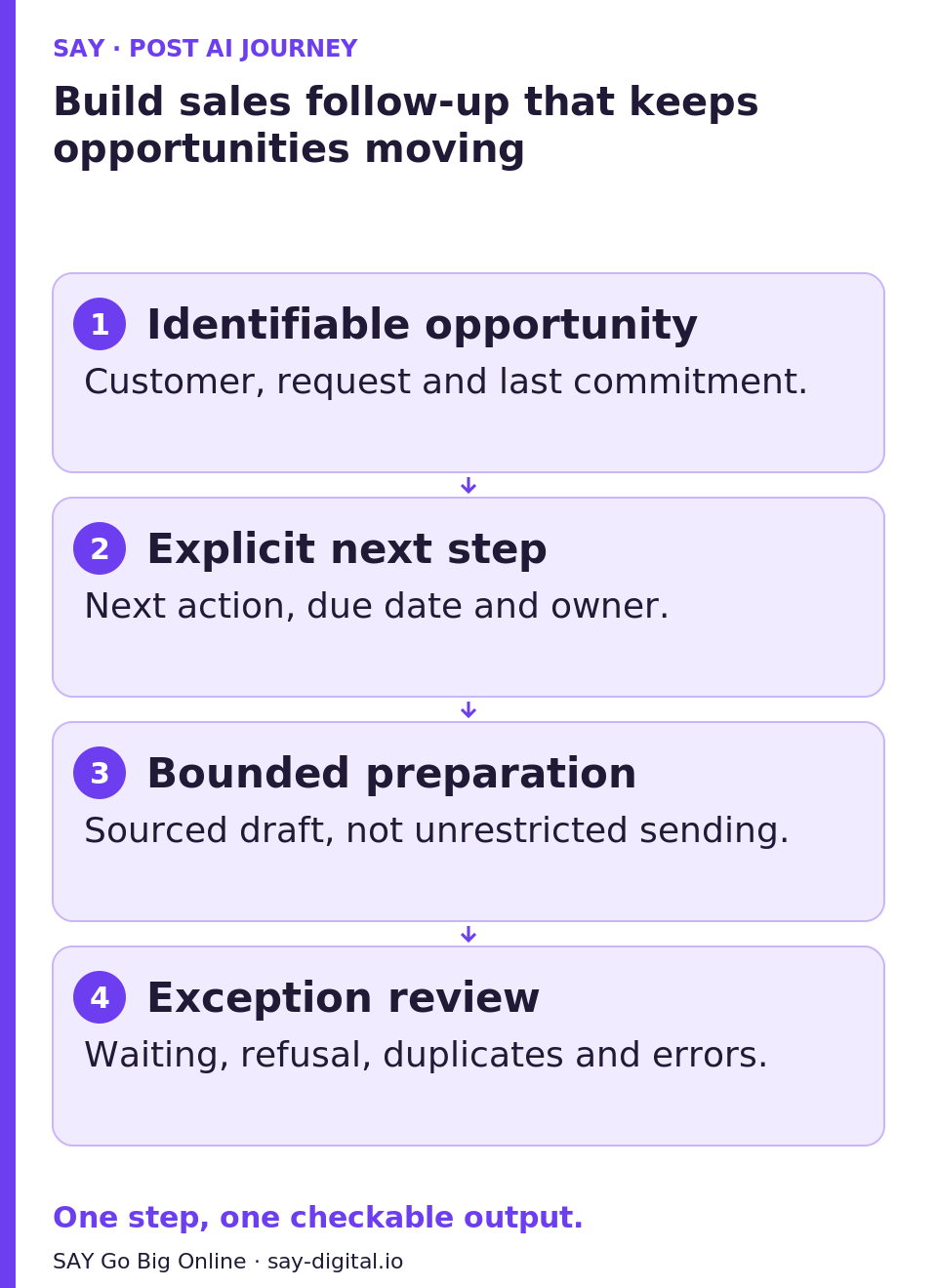
This produces a checkable chain: an identified opportunity, evidence of the last commitment and an assigned next action. The diagram summarises that handover before you define the preparation boundary.
3. Give your AI Worker a bounded preparation task
Use a limited instruction: “From the authorised records and exchanges, prepare a proposed next action for the owner. Cite the last commitment, flag missing information and stop before sending anything.” The expected output is a record and, where useful, a draft. It does not change a quote amount, a contractual deadline or a sales status without the required approval.
Define stop conditions for each opportunity: a request not to be contacted, a closed opportunity, uncertain identity, a possible duplicate, conflicting commitments or an inaccessible source. The system must hand the exception to the owner instead of inventing a follow-up. Separate reading permissions from editing and sending permissions in connected tools: instructions alone do not enforce those restrictions. The guide to why AI agents fail without clear business processes helps define the handover before automation.
4. Test the opportunity that must not receive a reminder
Run this exercise on an authorised copy with no real sending enabled. First write the expected result yourself for three situations: a clear commitment requiring follow-up, a duplicate and a recent reply asking for no further contact. Then have the system prepare its records and compare them with that reference alongside the sales owner.
- For the ordinary case, check that the action addresses the last commitment and includes its source and owner.
- For the duplicate, require a warning and no duplicate sending proposals.
- For the recent objection, require follow-up to stop and the owner to be notified, even when an older note recommends calling again.
- Remove access to the latest exchange: the output must say “information cannot be verified,” not “no recent message.”
Immediately before approving a draft, check the current conversation. A reply received since preparation may invalidate the draft. If that check cannot be completed, block sending. This negative test establishes something practical: the preparation must know when to stop, not merely how to write a persuasive message.
5. Keep a result record and review exceptions
Use one record per opportunity: identifier — contact and project — latest exchange checked at — last commitment and evidence — owner — next action — due or review date — stop condition — approval status. Add the test result, any required correction and the reviewer’s name. An overdue action must stay visible; its deadline must not be moved automatically to make the list look tidy.
At the sales review, start with unassigned rows, inaccessible sources, duplicates and overdue actions. The owner decides whether to resume, wait, transfer or close, recording the reason. Measure your own preparation, review and correction effort; drafts generated are not the same as opportunities advanced. If checking the output requires rebuilding every case, narrow the scope or improve the records before extending it.
6. Choose your next reading from the actual obstacle
If your exchanges are complete but their next steps are poorly recorded, return to the Twenty CRM guide linked above. If nobody knows who can approve or stop an action, work through the business-process guide first. These readings address different problems: preserving the next step from an exchange and assigning responsibility for carrying it forward.
Useful sales follow-up is not about multiplying messages. It makes commitments retrievable and handovers explicit. That is how an AI Worker supports your team rather than becoming another source of reminders. Bring your result record and a stop case to talk with a SAY expert. SAY Go Big Online can then define connections, permissions and acceptance of this preparation before expanding the actions it is allowed to take.