



Move from an AI trial to reliable business use
Move from an AI trial to reliable business use
Your AI demonstration produces a good answer from a carefully prepared case. The next day, a document is missing, two prices conflict or access is denied. These ordinary situations determine whether your team can use the system, not how fluent its first presentation sounded.
Moving from an AI trial to reliable business use requires an acceptance record and a workable recovery procedure. You will define what an AI Worker must deliver, what it must refuse and who takes over when there is doubt. The result is a small, supported use case whose expansion you can decide from observations, without immediately delegating its consequences.
No time to read? Get the essentials in video. — Audio in French; on-screen text in French.
1. Define an acceptable output before adjusting the tool
Choose one assignment, such as preparing a response to an enquiry using authorised documents. Describe its trigger, inputs and recipient. Specify the required contents of the deliverable: proposed answer, consulted references, information requiring confirmation and the decision needed from the reviewer. “A professional response” is not a sufficiently precise acceptance condition.
Add the defects that require rejection: unsupported information, an invented amount, a hidden contradiction or an action taken without permission. The person using the output must be able to accept or reject each point. Read why AI agents fail without clear business processes to understand why this comes before tool selection. Acceptance concerns a defined task, not a general impression of intelligence.
2. Turn difficult situations into acceptance cases
Build a set of authorised test cases, removing unnecessary sensitive information where appropriate. Write the expected output for each case before running the system. A complete case should produce a sourced preparation. A missing document should lead to a specific request for additional information. Conflicting sources must remain visible, with a request for the appropriate person to resolve them.
Add a denied-access case: the system must neither bypass the restriction nor report an inability to access a document as proof that it does not exist. Include an out-of-scope request, such as sending a customer email when only drafting is allowed. The expected result is an explicit stop. These negative tests examine service boundaries as seriously as the quality of an ordinary answer.
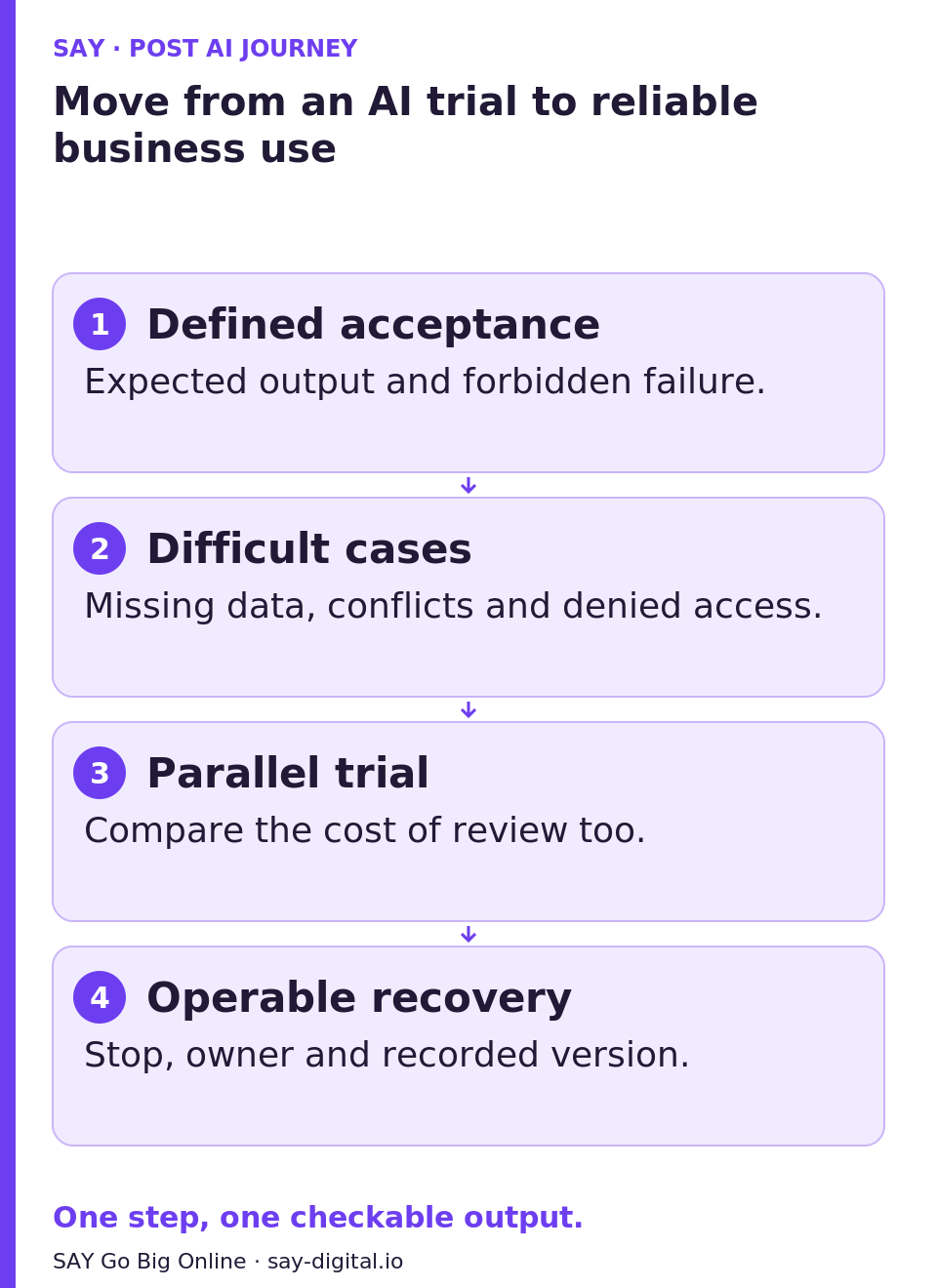
Your test set now connects an expected output to each situation, including cases where withholding an answer is the correct decision. The diagram shows how to move from these acceptance conditions to supported operation.
3. Run a shadow trial without changing live work
Keep your usual method as the decision-making route. The AI Worker independently prepares the same deliverable without sending messages, editing production records or triggering payments. The owner compares its proposal with the reference work. This parallel operation lets you observe mistakes without exposing customers or live cases to their consequences.
- Freeze a version of the instructions, test sources and settings; give the trial an identifier.
- Run ordinary and difficult cases without silently changing instructions between results.
- Ask the reviewer to mark each result accepted, needs correction or rejected, recording the defect and its evidence.
- Record preparation, reading and correction effort, along with available tool costs.
- After a change, replay the complete set: fixing one case must not break another.
Anthropic recommends starting with a simple solution and adding complexity when the need justifies it. If a fixed rule fulfils the assignment more clearly, keep that solution. An autonomous agent is not a requirement for a successful trial.
4. Give human review a named owner and a real place in the process
Name the person who accepts the outputs and a backup. Give them access to the evidence required for review without automatically expanding the system’s permissions. The review must expose the records used, uncertainties and proposed action. If the reviewer has to find everything again, the preparation is not yet easy enough to check.
Before the trial, agree on blocking defects and acceptance criteria relevant to your activity. An unauthorised action or exposure of sensitive information requires a stop; wording that needs improvement may require correction. Record those decisions instead of inventing a universal success threshold. The NIST AI Risk Management Framework provides a reference for governing, mapping, measuring and managing risks. It is not a certification of your particular use case.
5. Write and test stopping, rollback and recovery
An owner must know how to disable the trigger and remove the relevant action permissions. Document where to do this, who has authority and how to verify that queued work cannot continue. When an error occurs, preserve the case record and notify the person taking over. Do not automatically retry work whose possible effects remain unknown.
Distinguish restoring a known version from undoing an action. You can restore instructions and settings; you cannot assume that an email already sent has been recalled. In that situation, the owner assesses the consequences and arranges corrective action. Test the procedure on a test case: effective stop, queue inspection, manual handover and authorised restart. Record instruction, model, tool and source versions so you can identify what changed.
6. Complete the result record before expanding the scope
Your acceptance record brings together: assignment — owner and backup — authorised inputs — expected output — prohibited defects — test cases and results — versions — review effort — stop procedure — recovery — dated decision. Connect every result to its case and reviewer. Continue within the same scope when the output is useful and exceptions are handled properly. Narrow or suspend it when a blocking error occurs or when review means doing the work again.
For your next reading, return to the business-process guide if responsibilities remain unclear. If your first use case concerns sales opportunities, the guide to Twenty CRM and the next sales action provides a concrete setting for these acceptance checks. Expand only one dimension at a time: a new type of case, a new source or a new permission, with corresponding tests.
Reliable use turns a demonstration into organised responsibility: your business retains its evidence, decisions and ability to recover. Bring your acceptance record to talk with a SAY expert. SAY Go Big Online can help frame a first AI Worker around work that is checkable and maintainable before you give it additional responsibilities.