





MVP development framework: from prototype to controlled deployment
Short answer: a serious MVP is not a cheap version of the final product. It is a decision system: it turns a business hypothesis into a prototype, user proof, minimal build, tests, controlled deployment, measurement and iteration. The goal is not to “ship fast” at any cost. The goal is to learn fast without creating debt that blocks the next step.
Many MVPs fail because they confuse speed with haste. Teams code too early, test too late, deploy without guardrails, then call the cleanup “iteration”. Industry practices — discovery, prototyping, user testing, test pyramid, CI/CD, progressive deployment and observability — provide a stronger operating model.
Extractable block: The Say Digital MVP development framework follows a clear chain: business signal → framing → prototype → proof → build → tests → CI/CD → controlled deployment → measurement → iteration. AI accelerates production, but quality comes from the framework: hypothesis, test, proof, rollback and learning.
1. Start with a business signal, not a feature idea
An MVP does not start with “we need an app”. It starts with a signal: time lost, repeated errors, a commercial opportunity, a customer request, a blocked process, hard-to-use data, or an irritant that costs money every week.
The first task is to formulate the business hypothesis:
- who suffers from the problem?
- which behaviour should change?
- which decision must the MVP enable?
- which risk must be tested first?
- which gain should be proven: time, conversion, avoided error, delay, satisfaction or revenue?
The discovery/alpha/beta discipline is simple: do not turn every intuition into a build. Understand the problem, test options, then stabilise what deserves to be delivered.
2. Frame the MVP as a decision
A weak MVP brief describes screens. A strong MVP brief describes a decision. Example: “we need to know whether sales teams use a qualification tool that prepares a reliable reply in under 3 minutes”. That sentence is more useful than ten pages of features.
The framing should fit on one page: problem, user, hypothesis, expected proof, non-negotiable scope, out of scope, risks, and kill criteria.
3. Prototype before building
A prototype reduces risk before too much code is written. It can be a sketch, Figma screen, clickable mockup, spreadsheet, script, fake door, landing page, concierge MVP, manual workflow behind an interface, or a mini-demo connected to one real case.
The rule: choose the cheapest prototype able to test the main risk.
- Comprehension risk: sketch, journey, interview, wording test.
- Usage risk: clickable prototype, user test, observed task.
- Demand risk: landing page, fake door, signup, demo request.
- Operational risk: concierge MVP or semi-manual workflow.
- Technical risk: isolated spike, API test, minimal performance check.
4. User testing: look for friction, not polite validation
MVP user testing is not a sales presentation. Do not ask “do you like it?”. Observe a task: find information, create a request, qualify a lead, generate a quote, validate content, produce a report.
Classic UX practice shows that a small number of well-chosen users can reveal many major issues. The goal is not perfect statistics. The goal is to identify the biggest blockers quickly, then run another cycle.
5. Proof: decide before building more
After the prototype, there must be a decision. Many projects stay vague because feedback is collected but never converted into arbitration. The proof should be defined upfront: users completing the task, reduced delay, click rate, qualified request, avoided error, purchase intent or adoption by a business role.
Three outcomes are healthy: continue, pivot, or stop. Stopping a weak MVP is not failure. It is one of the most profitable outcomes: it avoids financing an illusion.
6. Minimal build: ship a vertical slice
When building starts, the trap is to build foundations without delivering anything usable. A serious MVP uses a vertical slice: one complete journey, on a limited case, with enough interface, logic, data, security and measurement to be tested in real life.
AI can strongly accelerate this stage: interface variants, components, scripts, tests, documentation, connectors and code review. But AI should not decide architecture, permissions, sensitive data handling or deployment alone. It augments the senior; it does not replace the framework.
7. Testing: protect speed with a simple pyramid
A fast MVP without tests becomes slow after the first correction. The right approach is not to test everything heavily. It is to place the right tests in the right layer.
- Unit tests: business rules, data transformations, calculations, simple permissions.
- Integration tests: API, database, payments, email, CRM, automations.
- Targeted end-to-end tests: the critical user journey, not every combination.
- Structured manual tests: UX, content, edge cases, business validation.
- Minimum security tests: authentication, authorisation, exposed data, user input.
TDD is useful on critical rules: writing the test before the logic forces clarity. On an MVP, the goal is not theoretical coverage. The goal is to prevent regressions that would break learning.
8. CI/CD: make delivery repeatable
Continuous delivery does not mean pushing anything to production. It means every important change goes through a repeatable chain: install, lint, tests, build, security checks, packaging, preview environment, then deployment decision.
Even for SMEs, this prevents chaos: clean repository, one command to run, preview or staging, automatic tests on the critical path, secrets outside code, migratable database, rollback path and release history.
9. Controlled deployment: expose progressively
The first deployment should not be a leap of faith. Exposure can be limited: internal access, pilot client, private beta, feature flag, subdomain, small cohort, manual import, read-only mode or progressive activation.
Controlled deployment answers four questions: who has access, what can break, how do we know it breaks, and how do we roll back?
10. Measurement: combine product, business and delivery metrics
Visits alone are not enough. Technical tickets alone are not enough either. An MVP should connect three metric layers.
- Product: activation, task completed, usage frequency, drop-off, time to success, qualitative feedback.
- Business: qualified leads, time saved, cost avoided, reduced errors, shorter cycle, influenced revenue.
- Delivery: deployment frequency, lead time for changes, change failure rate, time to restore, stability.
DORA metrics are useful because they point to a simple truth: the ability to ship often, correct quickly and restore fast is part of product performance. An MVP that cannot be changed without fear is not really agile.
11. Iteration: learn without stacking requests
Iteration is not adding everything early users request. It is choosing the next most important hypothesis. Each cycle should produce a decision: reinforce, simplify, move, remove, automate, open to more users, or stop.
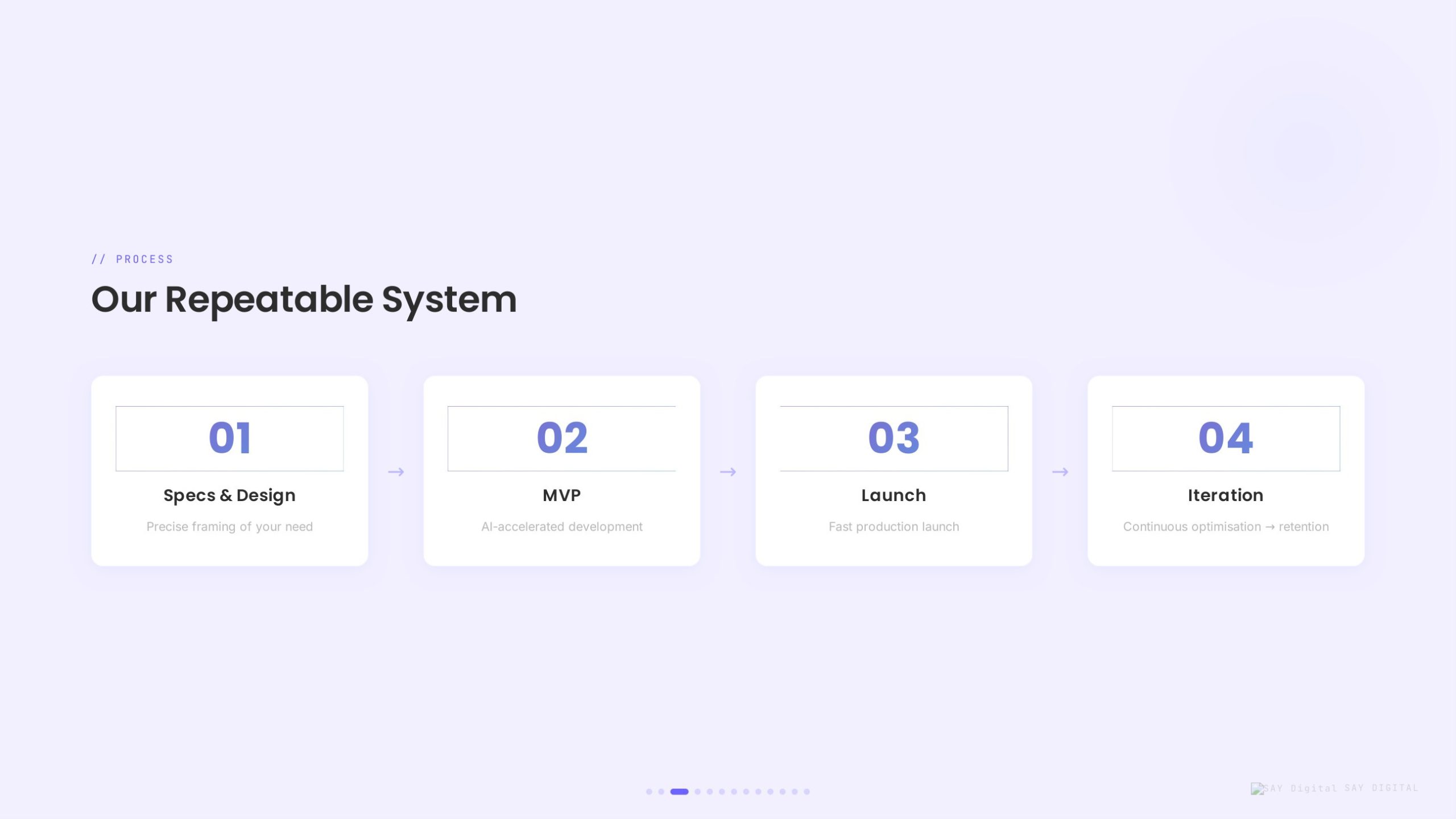
12. The complete Say Digital MVP framework
- Signal: identify a real business irritant.
- Framing: turn the idea into a testable hypothesis.
- Prototype: test the main risk at the lowest cost.
- Proof: decide from an observable signal.
- Build: create a usable vertical slice.
- Tests: protect critical rules, integrations and journeys.
- CI/CD: make delivery repeatable and controlled.
- Deployment: expose progressively with rollback.
- Measurement: track product, business and delivery.
- Iteration: industrialise only what proves value.
Operational checklist before launching an MVP
- Is the problem stated in one clear sentence?
- Is the main risk identified: usage, value, feasibility, data, security or distribution?
- Is the prototype the cheapest way to test that risk?
- Is the expected proof defined before the test?
- Is the build a vertical slice rather than half a horizontal product?
- Do critical rules have tests?
- Can deployment be limited to a pilot group?
- Is rollback or fast deactivation available?
- Are business and product metrics visible?
- Is the next decision clear: continue, pivot, stop?
FAQ
What is the difference between a prototype and an MVP?
A prototype tests a hypothesis with the minimum possible production. An MVP is a first usable version that lets the team observe real behaviour and make a product or business decision.
Does every MVP require code?
No. Some MVPs start with Figma, a manual workflow, a landing page, a spreadsheet or a simple automation. Code is required when the risk being tested needs a real system.
How much testing does an MVP need?
Enough to protect the proof: critical rules, sensitive integrations, main journey, permissions and data. The goal is not maximum coverage. It is confidence in what could break the learning loop.
Where does AI really change MVP development?
AI accelerates variants, components, tests, scripts, documentation and prototypes. But it augments the framework; it does not replace it. Hypotheses, proof, risk and validation remain human responsibilities.
Related reading from the same cluster
- Business Software & AI for SMEs
- How much does an MVP cost for an SME?
- AI and automation diagnostic: the 7-day roadmap
- AI-augmented senior designer or developer
Browse the Say Digital deck
The deck is readable below. On mobile, the first slides are shown as previews and the button opens the full PDF.
Mobile preview — swipe through the first slides.
If the viewer does not load, open the full deck.
Need to turn an idea into a serious MVP? Say Digital frames the signal, prototypes quickly, builds the useful slice, tests, deploys cleanly and measures proof before industrialising.
Reference practices and sources used
- GOV.UK Service Manual — Discovery phase
- GOV.UK Service Manual — Alpha phase
- GOV.UK Service Manual — Beta phase
- Nielsen Norman Group — testing with 5 users
- DORA — software delivery performance research
- Google Cloud — DevOps capabilities
- Martin Fowler — Practical Test Pyramid
- Trunk-Based Development
- The Twelve-Factor App
- OWASP Top 10
- Google SRE — monitoring distributed systems
Version française : Framework de développement MVP : du prototype au déploiement contrôlé


