



How Revolut rethought AI to cut costs and speed up development
How Revolut rethought AI to cut costs and speed up development
At Revolut, the question was no longer whether developers would use AI. It was how to give roughly 2,000 engineers access without letting every additional use drive up the bill.
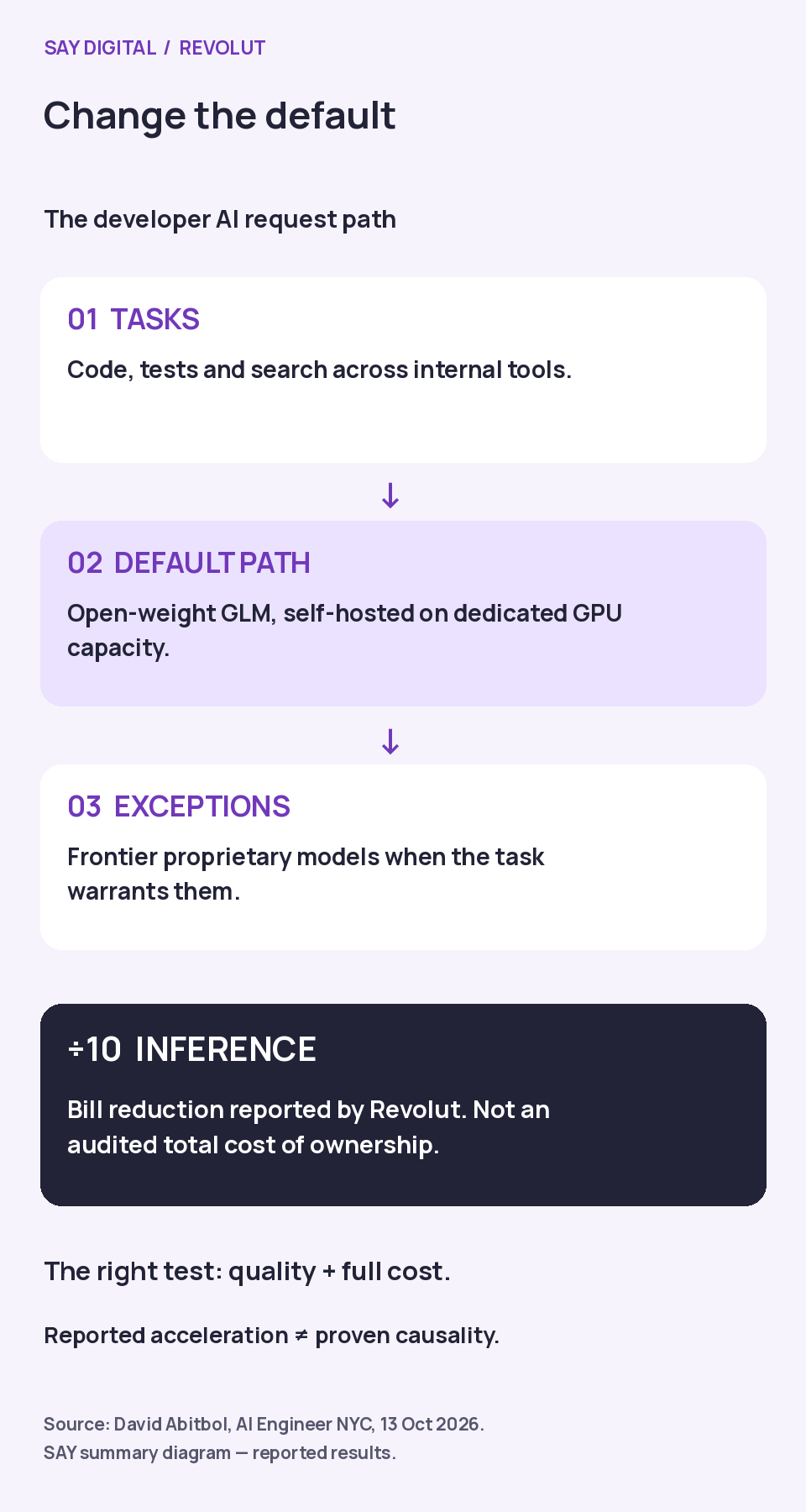
At AI Engineer NYC on October 13, 2026, David Abitbol, who leads AI operations at Revolut, described the company’s response: make self-hosted, open-weight GLM models running on dedicated GPUs the default. Proprietary models remain available for exceptions. Revolut reports cutting its inference bill to one tenth and describes faster development work. Understanding how those changes fit together is more useful than treating the headline as a ready-made business case.
No time to read? Get the essentials in video. — Audio in French; on-screen text in French.
Strict budgets protected spending, but constrained use
Abitbol described an early phase of adoption with tight spending limits. Some engineers, he said, were spending $1,000 a month, or even $10,000. Those were individual examples cited in the talk, not an average to multiply by Revolut’s engineering headcount.
A spending cap also shapes behavior. An engineer with a limited allowance may save AI for a difficult coding problem rather than use it to find information or understand a task. Revolut wanted to make routine use more affordable, instead of simply handing out larger allowances.
The team started self-hosting open-weight models in spring 2026. The talk mentions GLM 5.1 for that stage and GLM 5.3 for the infrastructure described in October. That is more than swapping a model name in a developer tool: Revolut takes responsibility for operating inference, the process of running the model when a request arrives.
The central decision: change the default, retain exceptions
Revolut did not announce an end to proprietary tools. Abitbol said that Codex, Claude Code and other frontier offerings remain valuable, but are used as exceptions. Self-hosted models become the first choice.
This changes the economics of consumption. With a usage-priced service, more requests generally mean more spending. Dedicated GPU capacity spreads infrastructure costs across the requests it serves, provided that capacity is sufficient. It is not unlimited: enough demand is needed to justify it, and additional capacity is needed when usage outgrows the service.
Quality therefore remains part of the decision. A cheaper request that takes three attempts or creates more code to fix may erase the saving. Keeping proprietary options for selected tasks avoids forcing every engineering job through the same compromise.
A tenfold inference reduction is not a complete IT cost comparison
In the talk, Abitbol reported a blended cost of $0.30 per million tokens, the units of text processed by a model, and an inference bill reduced to one tenth. These are figures reported by Revolut in a conference presentation, not an audited total cost of ownership.
That distinction matters when assessing the business case. Compute is only one expense. Operating the service, monitoring it, updating models, handling incidents and evaluating quality also require resources. Without a detailed accounting boundary, the talk does not establish that Revolut’s entire AI spending fell by 90%.
Scale also helps explain the architecture. Abitbol said that serving roughly 2,000 engineers with GLM 5.3 requires about 56 B200 GPUs. That describes Revolut’s setup; it is not a suggested starting configuration for a smaller business. Self-hosting alone says neither who owns the servers nor where they are located.
Faster development includes the work around code
One of the more revealing parts of the talk concerns work outside code generation. Abitbol pointed to finding information in messages, Jira and Confluence. With fewer constraints on access, engineers can use AI for those steps instead of saving their allowance for writing code.
Revolut reports improvements in coding time and lead time. In this presentation, lead time runs from an engineer picking up a feature to its being merged and ready to deploy. It does not necessarily measure the time until customers can use the feature.
The results also need an attribution boundary. The charts accompany several changes in tools and working practices; they do not isolate the causal effect of self-hosting. The spoken presentation and slide give different percentages for lead-time improvement. Reporting the direction of the improvement, rather than turning one percentage into a repeatable promise, is the more faithful reading.
What your business can take from Revolut’s decision
The transferable question is about allocation: which model should handle the routine workload, and which tasks justify paying for something different? You can test that decision before considering dedicated GPUs.
Choose a specific development task, such as preparing tests for an authorized repository. Compare candidate tools on the same work: accepted results, errors, review time, response latency and full cost. A lower token price is not enough if human effort rises. Conversely, more affordable access may make AI useful for steps that engineers previously skipped.
If self-hosting becomes a serious option, review the terms of the actual model version. Open weights do not mean every release uses the same license: GLM 5.3 weights have specific terms. Legal suitability and the ability to operate the service belong in the same decision as performance and cost.
At SAY Digital, the lesson we take from Revolut is to start with the work being completed, measure quality and cost, and then choose the architecture. For your team, the first step is a task worth comparing, not a GPU order. Let’s discuss the first workflow you want to evaluate.