

Your business depends on AI. Does it depend too much on one provider?
Your business depends on AI. Does it depend too much on one provider?
Anthropic has announced a filing for a proposed initial public offering. Its financial disclosures bring a question into focus for smaller businesses too: behind your AI subscription, a supplier funds computing capacity and makes commitments stretching over years. Your business is already organising work around its service.
If that service saves your team time, reading its accounts does not erase its value. But what happens to sales follow-up, quote preparation or case handling if prices, quotas or access conditions change? You need to know what work you could continue, at what cost and with which fallback.
No time to read? Get the essentials in video. — Audio in French; on-screen text in French.
A supplier’s accounts do not predict your next bill
Anthropic’s official announcement concerns a proposed offering, not a completed transaction. The amended SEC filing helps distinguish financial measures that are easy to confuse.
For the first half of 2026, Anthropic reports an operating loss of $693 million and positive adjusted operating income of $1.618 billion. The adjusted measure excludes certain charges; it does not replace the operating loss. Net loss also includes substantial accounting effects without corresponding cash outflows. It therefore does not, by itself, measure the cash consumed by the business.
The purchase and lease commitments described in the filing extend over several years. Presenting them as an annual debt would distort their meaning. These disclosures illuminate the supplier’s economic constraints; they establish neither an impending subscription price increase nor a service interruption.
You do not need to settle the question of Anthropic’s financial future to decide how to use its AI. You need to examine the work in your own business that now depends on it.
Look at the risk in one actual task
Consider an illustrative small services company. An AI Worker drafts a follow-up using a quote, previous correspondence and the next deadline. Someone checks the message before sending it. The service remains useful while the draft arrives on time, uses the right information and requires a reasonable amount of checking.
A usage limit reached at midday could leave follow-ups waiting. A different price could make a frequent task less worthwhile. A model change could mean more corrections. These are scenarios to test, not announcements about your supplier.
The useful measure becomes the cost per completed and accepted task: service and model usage charges, human review, corrections, repeated work and maintenance, divided by the number of usable completed tasks. A generated response that gets rejected has consumed resources without finishing the job.
Over the same reporting period, record tasks that were delayed or abandoned. Otherwise, a service handling only the easy cases could appear economical while leaving your team to complete everything else.
Identify what would prevent you from switching
If costs become too high, could another tool handle those follow-ups? The answer depends partly on the instructions and documents you would need to move. Before buying another subscription, identify the material that belongs to your business but may exist only inside the supplier’s service.
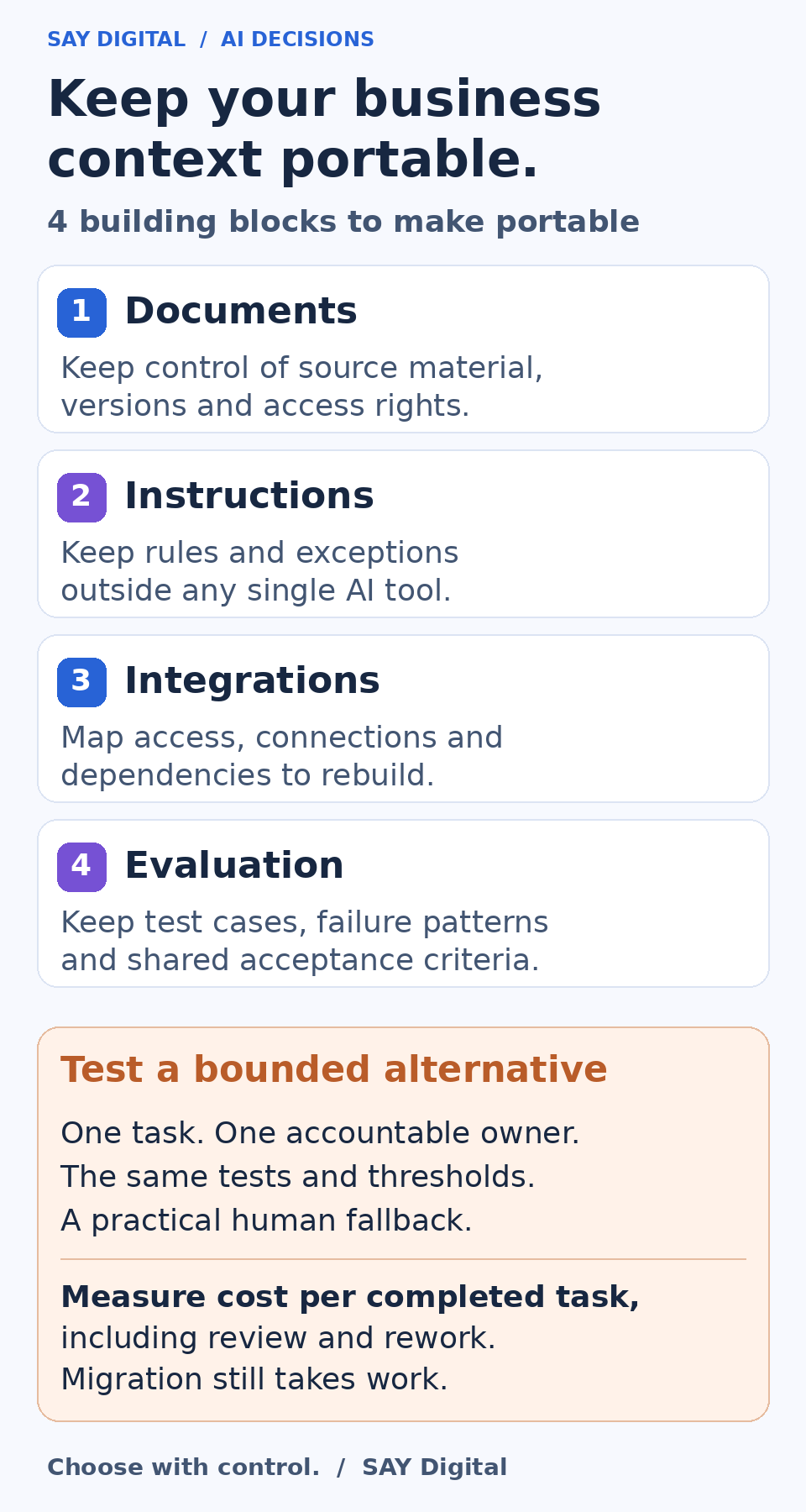
- Documents: where are the authoritative versions of price lists, contracts and case records? Can you export them in usable formats with their dates and access restrictions?
- Instructions: who keeps follow-up rules, exceptions and examples of the expected result? A conversation history is not enough to hand over a working method.
- Integrations: which permissions connect the AI to email, the CRM and documents? Who can revoke them, restore them and authorise another service?
- Evaluation: which cases let you check whether another solution works properly? Keep acceptance criteria, not just the current model’s successful answers.
This connects to retaining business context beyond a chatbot. The additional question here is practical: could that context support the same task elsewhere, under the same confidentiality rules?
Keep your reference material and the final say
You can keep renting a capable model while retaining a business reference you control: current documents, explicit rules and named owners. That is the starting point for building your own business intelligence, without having to train your own model.
Keeping a copy does not automatically give you permission to pass it to another provider. Check contracts, personal data requirements and authorisations. Decide who can pause the AI Worker, correct its instructions and take over a case. For a sales follow-up, the person authorised to approve sending must remain identifiable, whatever model is used.
A model-independent layer to keep your options open
With an agent such as Hermes Agent, you can reduce your dependence on a single conversational AI provider. Its model-agnostic approach supports different models and providers, including OpenRouter, Anthropic, OpenAI and DeepSeek, as well as compatible local endpoints. You can therefore organise your business instructions, reference documents and working environment in a layer separate from your chosen conversational service, rather than leaving everything in its chat history.
For your follow-up draft, this makes it possible to consider another available model without making its provider the owner of your working method. That choice still depends on compatible providers and capabilities, access actually configured and the integrations required. Test quality, cost and any adaptations on this bounded task; retain your access controls and human approvals. The official documentation of providers supported by Hermes Agent explains the connection options.
Test a fallback before you need it
Choose one task: preparing a follow-up draft without sending it, for example. Assemble a small set of authorised cases, including a missing document and conflicting prices. Run an alternative on the same material and compare the results against your usual acceptance criteria.
Record what needed rebuilding, errors, review time and missing access. Costing the trial distinguishes an available option from a provider’s name on a list. Moving may require rewriting instructions, rebuilding connections and repeating tests; no export guarantees an effortless migration.
After the trial, you can stay with the current provider while monitoring cost and limits, keep a fallback for this task or fund a targeted migration. Decide beforehand what would justify another comparison: a cost-per-task ceiling, a delay incompatible with customer commitments or a contractual requirement.
Become AI-First without losing your ability to choose
As AI becomes part of daily work, the buying decision changes. Answer quality still matters; so do keeping work running, checking it and taking it over. Your business references and decisions should not depend on the history stored in a single subscription.
SAY can help define that first task, the information an AI Worker needs and the decisions that must stay with your team. In a conversation with SAY, start with one important task and identify what you would need to preserve if your provider changed its terms tomorrow.