
The Friday report arrives earlier now that AI drafts it. Your team still spends the same time checking it, and nobody has changed a decision because of the extra pages. Production is faster; the work is not necessarily better.
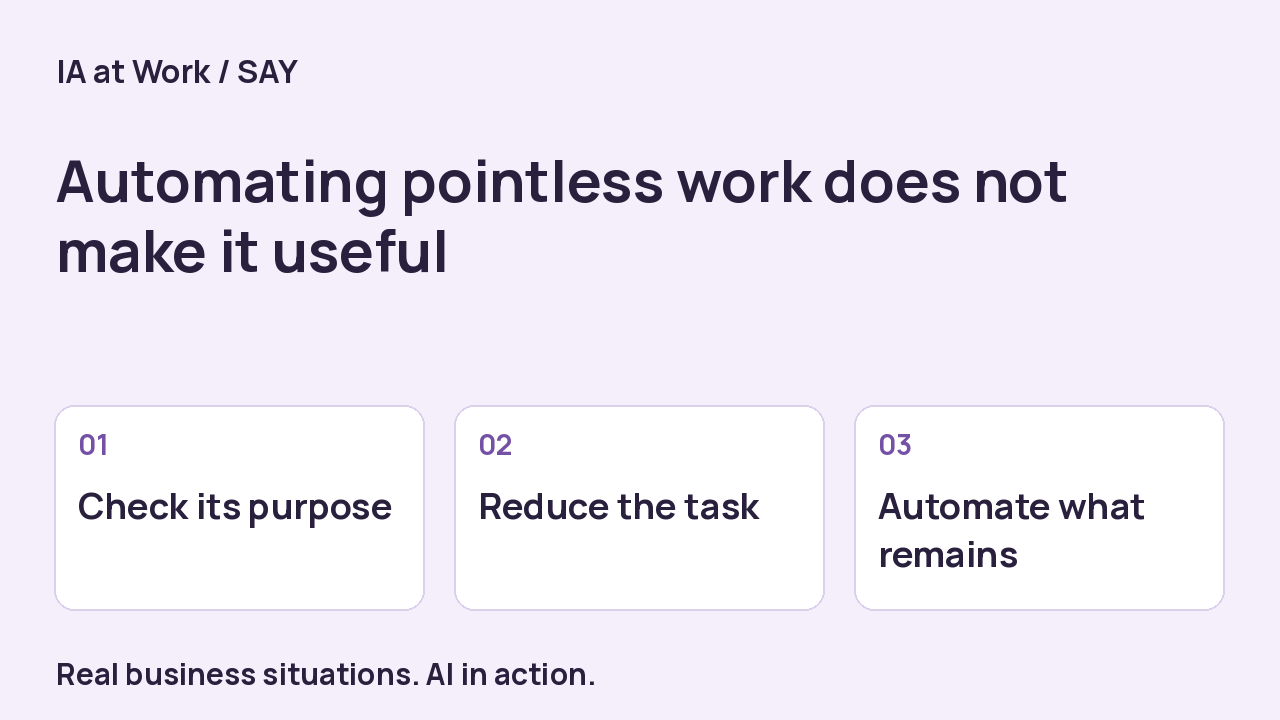
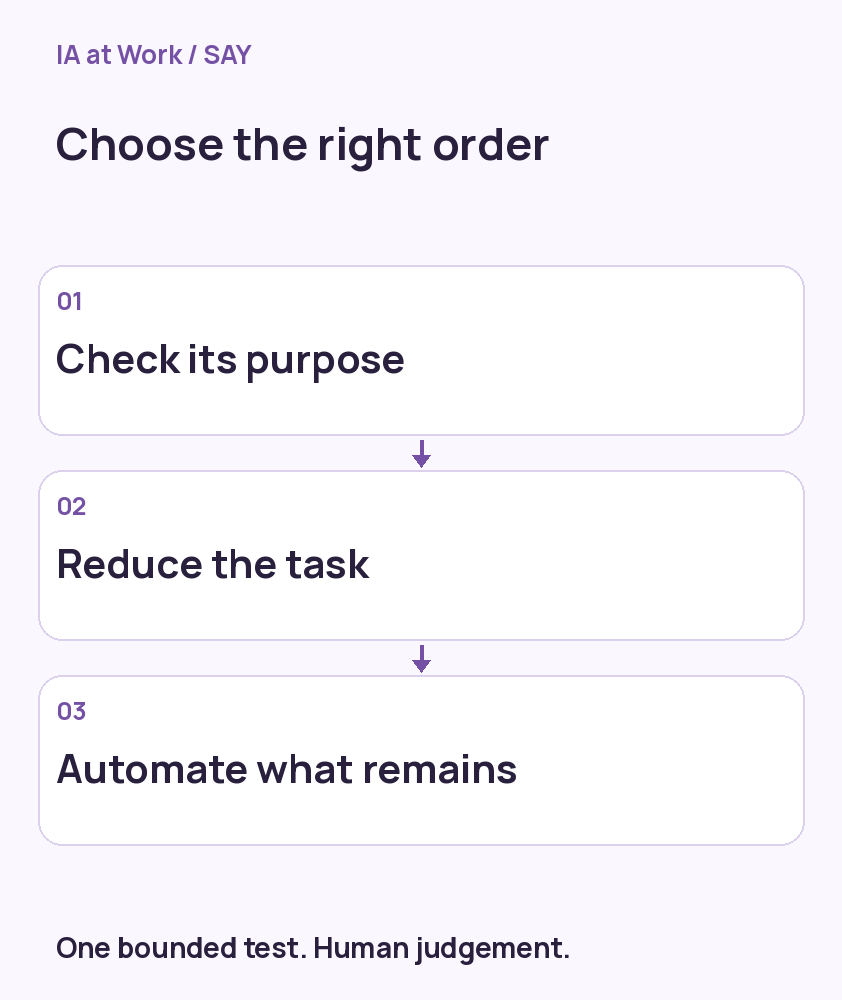
Before automating a task, identify the decision, service or obligation that depends on its output. If nothing depends on it, test removing it reversibly. If it remains necessary, simplify it before choosing a rule, integration or AI assistance.
No time to read? Get the essentials in video. — Audio in French; on-screen text in French.
Tim Ferriss’s question is practical
In the official transcript of podcast episode 887, Tim Ferriss criticises using AI to accelerate tasks that may not need doing at all. His observation is not a representative measurement of businesses. It supplies a practical question: what would actually be missing if we stopped producing this output?
A report may appear pointless because it is poorly presented while still fulfilling a contractual obligation. An appreciated document might merely repeat information available elsewhere. Ask the recipient and the owner of any obligation before deciding to remove it.
Follow the work to its recipient
In our illustrative scenario, the author saves time, but the director must still find exceptions, request evidence and decide what to do. Include that review and correction effort in the comparison. A fast output that someone else must repair transfers workload rather than removing it.
Take the last report and ask which decision it helped. If the reader mentions one exception, a short alert with a source may serve them better. If an audit requires the history, retain the record while separating it from the decision message.
Remove reversibly, not recklessly
An owner can pause an output within a limited scope after checking obligations and dependencies. Inform recipients, keep the underlying data accessible and define a way back. Restore the service if the trial exposes missing useful information.
A dependency tells you which function to retain. A full table might become a single alert sent to the right person when a business threshold is crossed. You have reduced the task before trying to automate it.
Choose the tool after reducing the task
A rule may be enough to compare an amount with a threshold. An integration can remove rekeying between applications. AI may help explain an exception from varied text, with sources and appropriate checking. These solve different problems.
Compare completed work at equivalent quality: production, verification, rework and coordination. Record errors or missed decisions during the trial too. Otherwise, time saved on a draft can conceal extra work imposed on everyone else.
SAY Digital can examine one workflow with its producers and recipients, then propose a limited trial. The useful project may be an AI Worker. It may also be a simpler rule or one fewer document.
SAY Go Big Online — discuss your first use case
Continue exploring this case
References and limitations
These references explain mechanisms and risks. The situations are illustrative; no quantified client benefit is claimed.