
Hermes Agent vs Limova: business agents or a configured agent for marketing, sales and service?
Your agency is launching a new service. The website describes one scope, the sales email adds an extra deliverable, and the customer-service reply still refers to the old package. None of the documents looks obviously wrong on its own. You discover the problem when a client expects something you never intended to sell.
Choose Limova first if its business agents and supported tools match your work and you do not want to operate an installation. Consider Hermes Agent when you need more specific rules for shared documents, permissions and recovery. The useful comparison is not how many agents you get. It is whether a decision survives the handoff from marketing to sales and customer service.
Short on time? Watch the article essentials.
French audio · English captions.
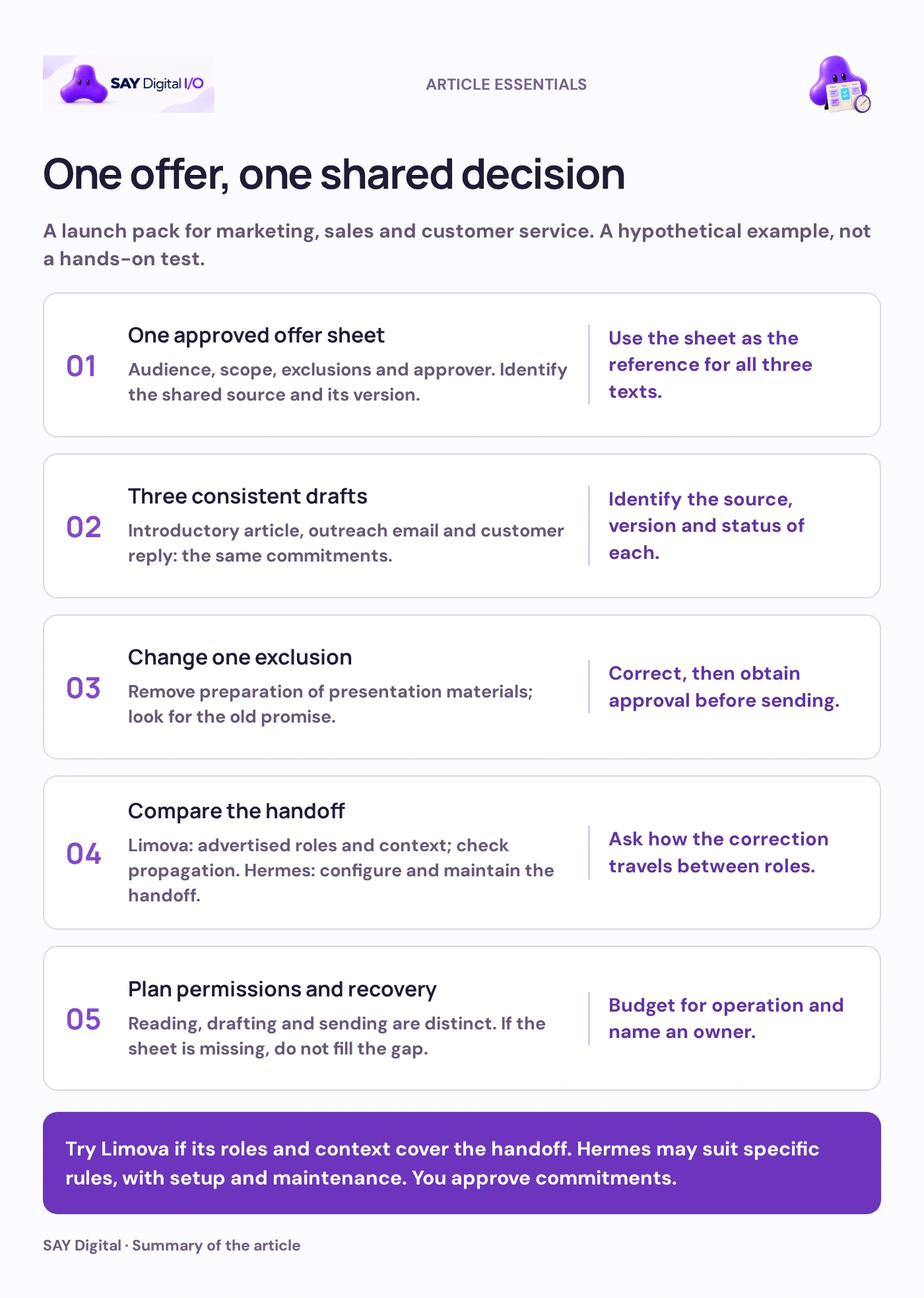
Open the full infographic ↗
Compare one deliverable: a service launch pack
Imagine a small agency launching an advisory service. This is a hypothetical evaluation scenario, not a test we have run. Both options should produce the same pack: an approved offer sheet, an introductory article, an outreach email and a draft answer to a customer’s scope question.
The offer sheet identifies the audience, deliverables, exclusions, conditions and approver. Each draft must reflect those decisions rather than quietly expand them. If weekend support is excluded, a customer reply must not promise it just because that sounds more helpful.
Give the offer sheet an identifier, a version date and an approver. Ask each draft to identify the source version, its status — proposed, needs correction or approved — and any open decisions. These are acceptance requirements for your pack, not features to assume either product includes. A fresh suggestion must not silently replace the approved offer.
Limova offers a practical starting point by business role
Limova markets a catalogue of agents for tasks including marketing, SEO, prospecting and document generation. Its plans page describes packages and onboarding support. Starting with an identifiable business role can suit an owner who wants a usable service rather than responsibility for a technical setup.
Lou, its SEO and content agent, is a concrete example. The vendor describes site audits, article writing and editorial planning, along with connections to WordPress, Wix or Shopify. The page says articles are placed in draft for approval. It would be misleading to describe Limova as a collection of chat personas with no ability to act in connected tools.
In your launch pack, Lou is a candidate for the introductory article. The official FAQ also describes customisation of tone, business rules and connected tools. Check which integrations and permissions are available for the agent and account you intend to use. Listing an application is not evidence that every agent can perform every operation inside it.
Limova’s home page also describes Charly as supervising the agent team. It presents Charly+ with automatic context and training on your documents. That coordination and context layer deserves consideration; it is not fair to assume Limova’s roles are isolated. Those statements do not, on their own, explain how source versions and corrections travel through your launch pack.
The handoff needs a closer look. The pages reviewed do not establish that changing an offer sheet automatically updates drafts across all roles. That is an evidence gap, not proof that Limova cannot support the process. Ask to see how context is retained and how another role retrieves the latest approved decision.
Hermes Agent lets you specify the handoff, with work to do
Hermes Agent is an open agent you can install and connect to tools. Its documentation describes persistent memory for selected information across sessions and scheduled tasks for recurring work. These are building blocks, not an already assembled launch process for your business.
You can specify a reference offer sheet, require it to be consulted before drafting, and record which version each output used. The procedure and connections still need to be implemented. Bounded agent memory is not a document repository; a structured Company Brain is an additional system, not an automatic native Hermes feature.
The Hermes Agent business guide explains the broader relationship between models, tools, memory and supervision. For this decision, concentrate on who can change the offer and who can approve the resulting copy. Without that ownership, a flexible setup can generate conflicting versions just as easily as a hosted service.
Budget for the work that remains after setup
For Limova, identify the subscription and options needed for your actual scope. For Hermes, include model usage, any hosting, integrations and maintenance. Open software is not the same as a cost-free operation. A hosted platform, meanwhile, does not take responsibility for promises you approve in customer-facing copy.
Limova’s terms of sale place responsibility for final generated content and its use with the customer. Check applicable conditions, data access and exit arrangements before committing. Confirm the price and options applicable to your account. A general productivity claim is not a measured outcome for your business.
With Hermes, assign an owner for broken connections and failed tasks. Running the agent on your own infrastructure does not mean all processing stays there: model providers and connected services also matter. The controls described in the security documentation need to match the permissions you actually grant.
Evaluate a change of scope, not just a polished first draft
Give both options the same non-sensitive offer sheet and keep all outputs as drafts. Then change one exclusion: the service no longer includes preparation of presentation materials.
- Does the change appear in the article, outreach email and customer reply?
- Can you identify the source version and anything still awaiting your approval?
- Can somebody else recover the pack when a tool disconnects or the usual operator is away?
A useful result flags the old customer reply promising presentation materials, corrects it and holds it back from sending. If the source sheet cannot be accessed, the draft stays unresolved rather than filling in the gap. Separate permission to read, to draft and to publish or send: document access is not permission to make a commercial commitment. Do not expand the scope while that contradiction remains.
Watch how much reconciliation you still have to do. If every answer requires you to reread the entire offer, more agents have not solved the handoff. If Limova handles it cleanly, avoid building unnecessary infrastructure. If your approval rules are unusually specific, a configured Hermes setup may earn its maintenance cost.
Start with one shared decision
If all you need is an article draft, one specialist role may be enough. A more structured system makes sense when several functions must reuse the same decision and somebody can own its operation. Start with the pack causing real inconsistencies today rather than buying an entire team by default.
If you need help defining that first handoff, describe your AI project with SAY, create your account, and speak with a human before making a purchase. First Contact is quoted individually: a Brain, a few workflows and an agent team whose composition is defined in the quote. The point is to scope useful continuity, not push you towards either a catalogue or a custom build.