

ChatGPT or Hermes Agent: helping solo founders decide whether to take on a client project
A client wants to start a new project, but your schedule is already full. You need to weigh the request against existing commitments and prepare a sensible reply. Should you open ChatGPT or set up Hermes Agent to do the preparation?
Start with ChatGPT if you can bring the documents and work through the answer yourself. Consider Hermes Agent when you want the instructions, reference material and preparation work to live in a lasting, configured setup. ChatGPT Work also supports delegated and recurring work. The deciding question is who will maintain the sources, arrange when the work starts and take over if preparation stops.
This comparison draws on official documentation consulted on 15 November 2026, not a hands-on customer trial.
Short on time? Watch the article essentials.
French audio · English captions.
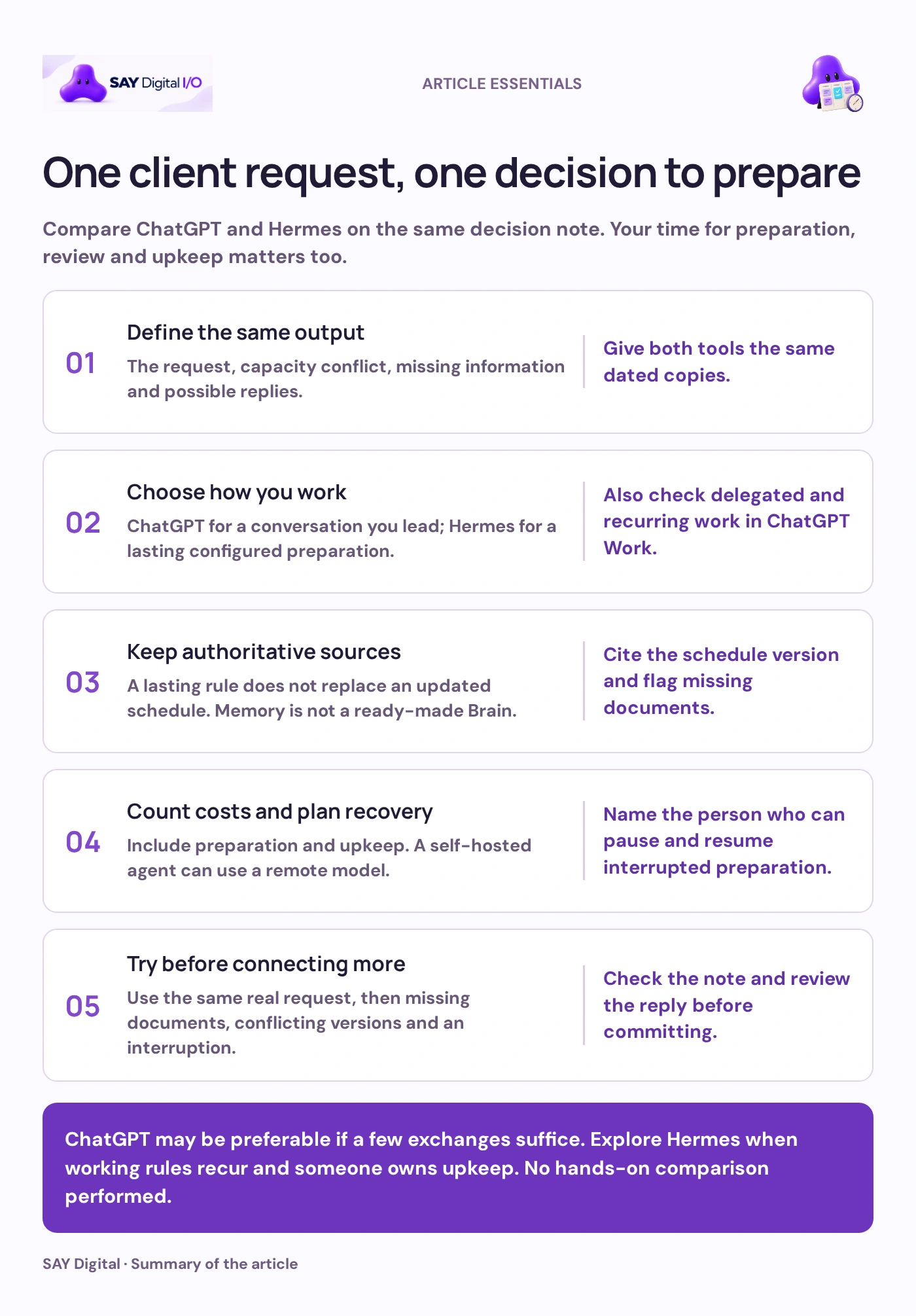
Open the full infographic ↗
Compare the same decision note in both tools
Imagine a small consultancy. A prospective project needs an early start, but the person who would deliver it is already committed elsewhere. Give either assistant the client's request, your service scope and an up-to-date capacity schedule. Ask for a short note identifying the request, the capacity conflict, missing information and possible responses.
A useful note might read: “The request is for full delivery, but the schedule already shows a commitment during that period. A shorter discovery phase could be discussed; capacity for it still needs confirmation. Ask whether the client’s deadline applies to discovery or to the completed project before replying.” This illustrates the desired output, not a run performed in either tool.
The note must distinguish evidence from suggestions. An empty availability field is not a free week. An enthusiastic client message is not an accepted quote. You decide whether to accept, narrow the scope or offer a later start; the proposed reply still needs your review.
ChatGPT suits work you want to shape in conversation
You can start by gathering the relevant documents and asking for an assessment, then change direction: “Keep the requested deadline, but propose a smaller scope.” This is useful when you are still working out what the project should include. You refine the question as the answer develops rather than designing a permanent setup first.
ChatGPT can also support delegated work. OpenAI’s current pages describe projects, scheduled tasks and ChatGPT Work, which can gather context, prepare a plan, handle one-off or recurring work and check in for your input. Documented plugins connect ChatGPT to services including Google Drive, Slack and SharePoint. ChatGPT Business also offers shared company context and administrative controls.
Availability depends on your plan, device and permissions. The Work page describes broad desktop access, while the pricing table excludes scheduled tasks from Free. Check the scheduling rights on your own account and the precise operation supported by your plugin. A connector logo does not establish that it can read or update the capacity schedule you actually use.
Hermes Agent lets you configure preparation around your working rules
Hermes Agent combines an AI model with tools, persistent memory and reusable procedures called skills. Its documentation also describes recurring tasks and delivery to configured channels. You could use it to prepare the same note from an authorised folder while retaining the instructions and output format.
For the client-project example, someone would need to identify the request, service description and schedule, define how their dates are checked and specify what happens when a document is missing. If a regular review is useful, a recurring task could prepare updated notes for requests still awaiting a decision, without sending replies to clients. On-demand preparation may be enough if these decisions are infrequent. This requires configuration and testing; installing Hermes does not deliver the process on its own.
That setup may be worthwhile when several requests follow the same rules. Someone must also maintain access and check the results. If that person is you and you have no time for the responsibility, ChatGPT may remain the better choice.
Remembering a preference is not the same as knowing current capacity
This is not a choice between a supposedly memory-free ChatGPT and an all-knowing Hermes. ChatGPT projects and shared context, as well as Hermes memory, help preserve context. Their behaviour and access need to be assessed in the setup you will actually use.
Hermes has bounded native memory organised by profile. It can retain a presentation preference or a lasting rule, but it does not automatically provide your Company Brain. That Brain is an organised collection of business knowledge and references that needs deliberate preparation and upkeep.
“Check capacity before promising a start date” is a lasting rule. “Next week is free” is a perishable fact. Keep an authoritative schedule and ask the note to identify the version it used. Otherwise, an old conversation can quietly become the basis for a new commitment.
Count the time you cannot spend serving clients
For ChatGPT, consider the appropriate subscription, usage limits, connected services and your own preparation and review time. A hosted interface removes the need to operate the agent infrastructure yourself. It does not organise your documents or settle access permissions for you.
For Hermes, include the model, external tools, hosting, knowledge preparation, integrations, testing and maintenance. A subscription to a chat application does not automatically cover every way another program might use a model. Hosting the agent yourself also does not mean every piece of data stays on your machine: a configured model or service may run elsewhere.
Ask for setup, ordinary running costs and ongoing upkeep to be estimated separately, including incident handling and leaving the setup. Open-source software does not remove those costs; a hosted subscription may not cover every connected service. Without your workload and the relevant provider terms, neither option is an established price winner.
The arrangement must work when you are away. Document how to pause the task, find its last output and complete the preparation manually. Plan a handover record showing source dates, the note’s status, why preparation stopped and who should be notified. Check separately whether a reply has already been sent before restarting an action. That arrangement needs to be built and tested; it does not follow automatically from either product name. Without an owner for recovery, an automated note becomes another item on your monitoring list.
Use a real request before connecting more systems
Take a recent client request. Give both options the same dated copies and acceptance criteria, then compare their notes with the underlying documents. Does the note identify capacity already committed? Does it ask for missing information rather than invent a date? Does the reply reflect your chosen option? Then check what happens when the schedule is unavailable or two versions disagree. Ask the designated backup person to resume an interrupted preparation: can they find the sources and finish the note without asking you to explain everything again?
If a few exchanges in ChatGPT solve the problem, there is no need to create infrastructure for its own sake. If you repeatedly rebuild the same context and have someone to maintain it, explore a configured Hermes setup. Also assess the Work features already available in your ChatGPT account: recurring work is not exclusive to Hermes.
The Hermes Agent business guide explains the model, tools and memory if you want to examine that route.
Scope the delegation before making a purchase
With SAY Digital, start with your AI project, create your account and speak to a person before purchasing. Bring the client request, the output you need and the name of the person who can take over if the process stops.
If First Contact is the right next step, its quoted scope brings together a Brain, a few workflows and an agent team whose composition is defined in the quote. The scope should follow the work you need delegated, not an impressive agent count. You should be able to name what will be prepared for you and which decisions remain yours.