





Hermes Agent: a business guide to AI agents, tools and human control
Hermes Agent: a business guide to AI agents, tools and human control
Asking AI to prepare payment reminders sounds straightforward. Then it has to find the right invoices, recognise a disputed balance, apply the payment terms and stop before sending an inappropriate message. That sequence of decisions is where an agent can help — and where a business needs to define its limits.
Hermes Agent is an open-source agent framework built by Nous Research. It connects an AI model to tools so it can carry out a multi-step task: consult a source, take an action, inspect the result and continue. What it can actually do depends on the integrations and permissions it receives.
This guide explains what Hermes does, how corrections can improve its future work, and why the company’s approved knowledge must remain separate from the agent’s own memory. The aim is to choose a useful first assignment without mistaking a successful demonstration for dependable autonomy.
Hermes Agent, AI model and chatbot: what is the difference?
The AI model interprets the request, generates text and can propose tool calls. Hermes Agent manages execution: it assembles context, dispatches calls to available tools, collects their results and returns them to the model. The chat interface lets a colleague give instructions and receive a report.
A chatbot can also have tools. The useful distinction is therefore not whether there is a chat window, but whether the system can complete a sequence of verifiable actions. If the invoicing system is not connected, typing “analyse my overdue invoices” does not give the agent access to them.
Hermes is not tied to one model. Choosing a provider or a local model remains a trade-off between capability, cost and confidentiality. Running Hermes on your own server does not mean all data stays there: information sent to a remote model or service still passes through that provider’s systems.
What happens when you give Hermes a task?
Consider an illustrative scenario, not a client case: “Review overdue invoices and prepare this week’s payment reminders.” With the necessary integrations and read-only access, the task could run as follows:
- Load the working rules. Hermes receives the request, the reporting period, the permitted sources and a rule prohibiting sends without approval.
- Retrieve the invoices. The model requests the authorised connector. Hermes runs it and collects the available records.
- Check exceptions. A disputed invoice is set aside. If the dispute status is missing, the agent requests clarification rather than guessing.
- Prepare drafts. A calculation tool can check due dates; the model writes messages from the verified information.
- Request review. The responsible colleague checks recipients, amounts and tone. Sending remains outside the agent’s remit until it is authorised.
Each tool result can change the next step. A recorded payment should remove an invoice from the list; a failed connection should appear in the report. A generated draft proves neither that the source data was complete nor that a message was sent. The report must distinguish information retrieved, conclusions inferred and actions completed.
This action–observation loop lets the system do more than produce an answer. It also creates dependencies: working APIs, reliable records, access controls, cost limits and error handling. Our overview of what an AI agent can actually do for an SME helps identify a narrower first assignment than unrestricted access to every business tool.
What changes when Hermes “learns”?
Suppose the reviewer corrects the first attempt: “Never prepare a reminder while the client’s invoice is in dispute.” For that correction to help next time, it must be saved in the right place and retrieved during a future task. A sentence buried in an old conversation is not a dependable operating procedure.
Hermes supports persistent memory and skills: reusable knowledge documents it can load when relevant to a task. A skill might describe how to retrieve due dates, check exceptions and present a review list. A correction can become a reusable instruction, together with the checks needed to apply it.
This does not mean the AI model’s weights are automatically retrained. The context, procedures, stored memory and tools can change without changing the underlying model. Nous Research describes Hermes as a self-improving agent. That describes mechanisms for retaining experience; it does not establish that every business deployment will become steadily more successful.
The correction itself needs testing. “Exclude every customer with an overdue balance” would prevent some bad reminders by removing the very work the agent was meant to do. Before using a revised skill on real accounts, test it against representative cases: a recent payment, a dispute, a missing field and a duplicate invoice. Otherwise, the agent may simply repeat a bad rule more consistently.
Why is agent memory different from a Company Brain?
A skill explains how to prepare a reminder. It should not accidentally become the authoritative record of each customer’s payment terms. When those terms change, every agent needs the approved version, even if an earlier conversation still contains the old one.
In Say Digital’s proposed architecture, the Company Brain is the business’s authoritative knowledge base: approved procedures, offers, responsibilities, decisions and documents, with identifiable sources, dates and access rights. It is separate from an agent’s personal memory and should remain usable if the business changes model or agent framework. It is not a ready-made business capability automatically supplied by every Hermes installation.
Hermes can consult the references it is allowed to access and suggest changes. A suggestion becomes official only through the agreed approval process. Our guide to Company Brain and enterprise memory explains how to separate working notes from approved company knowledge and assign responsibility for updates.
What controls are needed before connecting business tools?
The more an agent can do, the more a reasoning error can affect the business. OWASP identifies “excessive agency” as a risk in applications built around language models: excessive functionality, permissions or autonomy can turn an incorrect output into a harmful action.
Hermes documents user authorisation, command approvals and isolation mechanisms. These do not replace CRM permissions, confidentiality rules or approval of a commercial commitment. A terminal-command approval check is not, by itself, an approval workflow for every email send or API request.
- Start with reading and preparation. Let the agent analyse records and produce drafts before granting write access.
- Match access to the assignment. An agent preparing payment reminders does not need payroll administration or the ability to delete customers.
- Specify human decisions. Sending, refunds, contract changes and publication need an explicit rule and an accountable reviewer.
- Define when to stop. Contradictory data, suspicious instructions inside a document or a failed tool call should allow the agent to pause and hand over.
- Keep useful evidence. Record actions and approvals without making the logs an uncontrolled duplicate of sensitive business data.
A document the agent reads may contain malicious instructions. Treating that content as untrusted data rather than a new source of authority is part of the system to test. None of these controls supports a promise of error-free operation.
How do you start without building an oversized system?
Choose an assignment with a result someone can check: preparing reminders, sorting incoming documents or producing a source-backed summary. Then name the person who will accept the work and the errors that require a stop. Those choices determine the sources, connectors and permissions required. Connecting every available tool first increases scope before proving usefulness.
In the reminder scenario, the first test can run without sending anything. Compare the agent’s selection with a list verified by the team, record missed exceptions and measure review time. Track total cost per task, human rework and incidents too. Faster preparation offers limited value if a colleague still has to reconstruct the entire analysis before approving it.
The Say Digital Framework connects that test to production: scope the need, prototype the task, establish evidence, then build and test the integration. Procedure and tool changes go through a controlled delivery cycle — including CI/CD where appropriate — before a limited, measured and reversible rollout. Access expands after accepted results, not after one successful attempt.
Costs therefore depend on exceptions and review requirements as well as model usage. Our guide to the cost of an AI agent for an SME separates design, integration and operating costs before a budget is agreed.
Questions to settle before the first pilot
- What must Hermes finish, and what evidence will show that it is finished?
- Which sources take precedence when a conversation contradicts them?
- Which tools may it read or modify, and within what scope?
- Who approves consequential actions and new procedures?
- Which results will justify continuing, revising or stopping the pilot?
For the reminder pilot, the answers should establish a clear division: the agent prepares a verifiable list, the reviewer approves it, and no message leaves without authorisation. If the team cannot yet describe that arrangement, the next job is to clarify the assignment, not connect more tools.
Your Hermes server, hosted and managed by SAY Digital
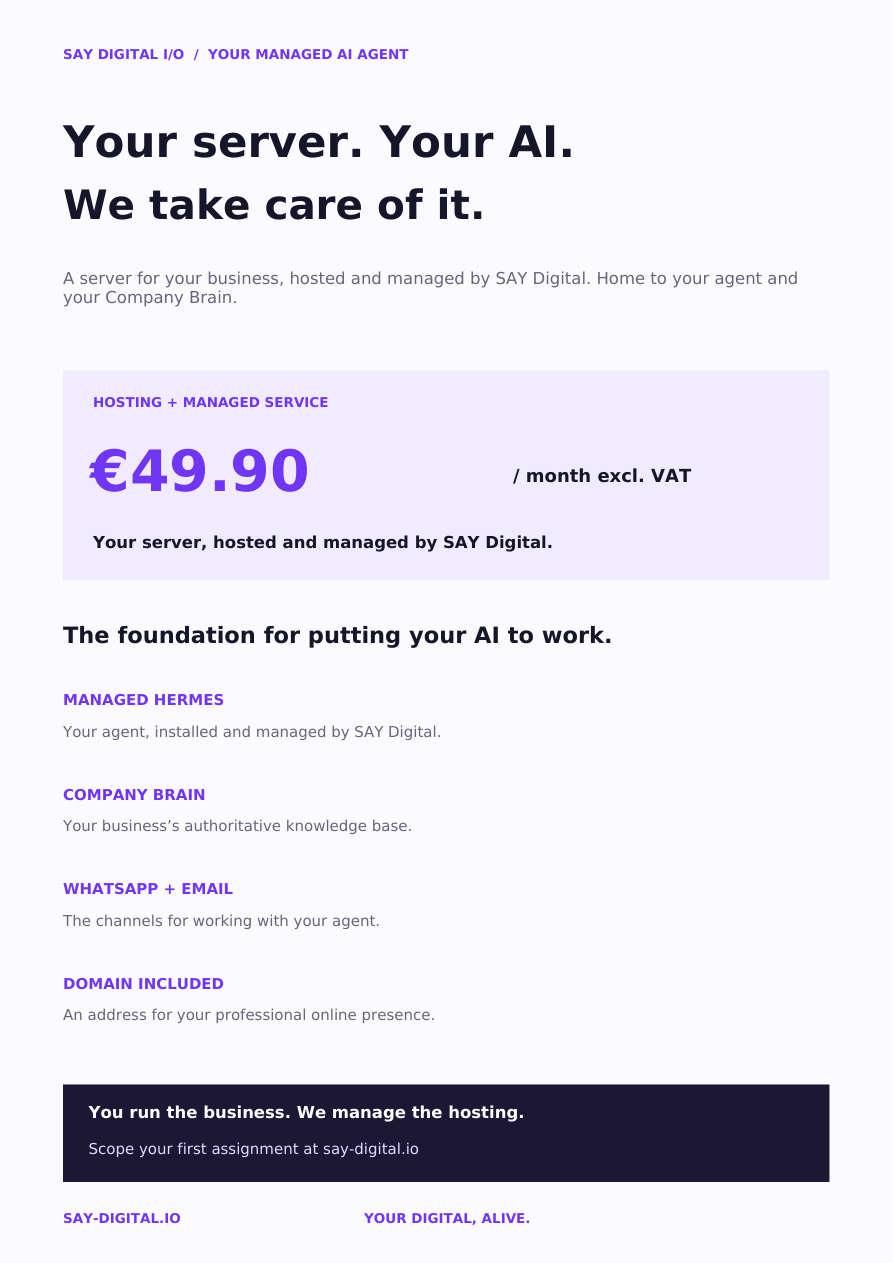
Once the first assignment is scoped, it needs an environment to run in. SAY Digital provides your server for your business, with hosting and a managed service for €49.90/month excl. VAT. You retain responsibility for business decisions; we manage the environment.
- Managed Hermes: your agent, installed and administered by SAY Digital.
- Company Brain: your business’s authoritative knowledge base.
- WhatsApp and email: channels for working with your agent.
- Domain included: an address for your professional online presence.
This price covers the hosted, managed foundation. Business integrations, model usage and the scope of the first assignment need to be agreed before starting. Consequential actions remain subject to your company’s approval rules.
Give Hermes Agent a useful first assignment
Does your team repeatedly look up information, apply rules and prepare an action? Say Digital can scope a pilot around that process: reliable sources, a bounded assignment, human approvals and acceptance criteria. The first expected deliverable is evidence that the task works for the business, before extending connections or autonomy.
Discuss your first AI agent with Say Digital
Sources and scope
This guide draws on Say Digital’s client guide to Hermes Agent and Company Brain, checked against the resources below on 15 October 2026. Official documentation describes project capabilities, not independently demonstrated business returns. The organisational recommendations and Company Brain architecture presented here are Say Digital’s approach.


